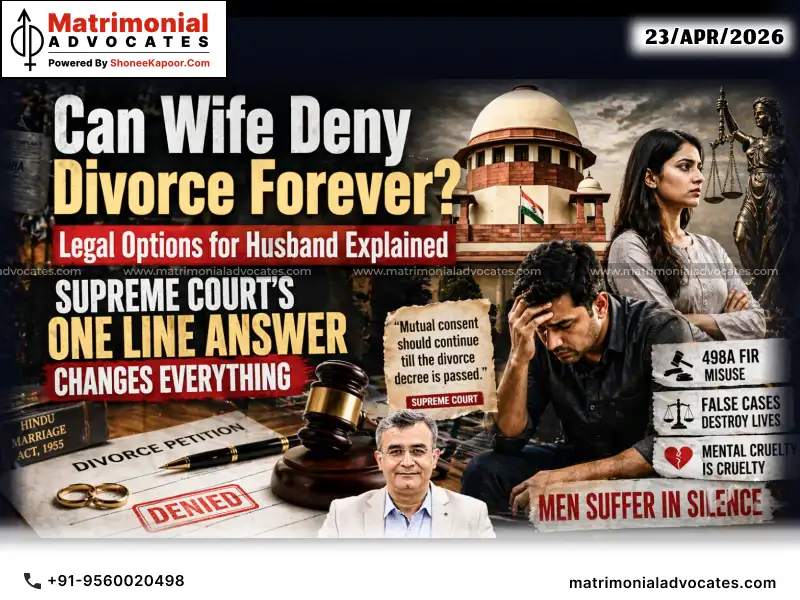
Can a wife block divorce forever in India? Understand a husband’s legal options under the Hindu Marriage Act, including cruelty, desertion, mutual consent failure, false cases, and Supreme Court rulings.
NEW DELHI: A wife can delay divorce. She can contest it. She can frustrate mutual consent. But under Indian law, she cannot legally keep a husband trapped forever if he proves a valid ground for divorce before the court.
Under the Hindu Marriage Act, 1955, either spouse may seek divorce on statutory grounds such as cruelty, desertion, adultery, conversion, certain forms of mental disorder, renunciation, or presumption of death. The law is not written to create a lifetime veto in the hands of one spouse.
The real problem is not that the law gives a wife permanent power to deny divorce. The real problem is delay, weak pleadings, poor evidence, avoidable procedural mistakes, and the confusion many husbands have between mutual consent divorce and contested divorce. Those are not the same battle.
Under Section 13B, mutual consent requires both parties to move together, and the court passes a decree only when the statutory requirements are met and the petition is not withdrawn in the meantime.
That is why the first hard truth must be stated clearly: if the case is for mutual consent divorce, the wife can stop that route by withdrawing consent before the decree is passed. The Supreme Court has reaffirmed that mutual consent must continue till the decree. In April 2026, the Court again stated that mutual consent is a sine qua non and that such consent must continue till the decree of divorce is passed.
But that is only the end of one route, not the end of the road. If mutual consent fails, the husband’s remedy is to move to a contested divorce on legally provable grounds. Section 13(1)(ia) allows divorce for cruelty, and Section 13(1)(ib) allows divorce for desertion of not less than two years immediately before the petition. Section 13(1A) also allows divorce where, after a decree for judicial separation or restitution of conjugal rights, there is still no resumption of cohabitation or no restitution of conjugal rights for one year or more.
So the answer to the title question is simple in law and brutal in practice: she cannot deny divorce forever, but she can force the husband to prove his case properly. And when husbands waste years waiting for consent from a spouse who has no intention of giving it, they hand over the only thing the other side truly wants—time. The statute itself expects matrimonial trials to move expeditiously and says there should be an endeavour to conclude trial within six months from service of notice, though everyone in practice knows actual timelines can be longer.
MUTUAL CONSENT DIVORCE: WHERE MANY HUSBANDS LOSE TIME
A large number of husbands are misled into believing that if both parties once filed for mutual consent, divorce is only a formality. That is wrong. Section 13B requires a joint petition, continued consent, and a second motion within the statutory framework. If consent is withdrawn before decree, the family court cannot force a mutual consent divorce.
The Supreme Court position is settled. A court cannot convert a broken mutual-consent attempt into a decree merely because one side once agreed. The line is clear: “Mutual consent should continue till the divorce decree is passed.” That single sentence destroys the myth that the first motion guarantees the second.
There is one important nuance. The six-month waiting period in mutual consent cases is not always mandatory. The Supreme Court in Amardeep Singh v. Harveen Kaur held that the cooling-off period under Section 13B(2) is directory, not mandatory, and can be waived in appropriate cases where the marriage has effectively broken down and there is no real chance of reunion. That helps only where both sides still want mutual consent. It does not help where one side has already chosen obstruction.
CONTESTED DIVORCE: WHERE THE HUSBAND STOPS BEGGING AND STARTS PROVING
Once mutual consent collapses, the husband must stop thinking emotionally and start thinking evidentially. The case now becomes one of grounds, pleadings, documents, witnesses, admissions, contradictions, and sustained conduct.
Under Section 13, the court is not deciding who is louder. It is deciding whether a legal ground exists and whether the petitioner is entitled to relief. Section 23 also matters because the court must be satisfied that the ground exists and that the petitioner is not taking advantage of his own wrong.
- Cruelty
Cruelty is the most frequently used and most misunderstood ground. It is not confined to physical violence. Mental cruelty is enough. The Supreme Court in Samar Ghosh v. Jaya Ghosh made it clear that there can be no straightjacket formula, but it laid down broad indicators. The Court said the listed instances are “only illustrative and not exhaustive,” and it specifically recognised that a long period of continuous separation may itself, in the circumstances of a case, lead to mental cruelty.
The same judgment contains one of the most important courtroom formulations in Indian matrimonial law. The Supreme Court observed that where there has been a long period of continuous separation, the marriage can become a legal fiction, and refusing to sever that tie may show “scant regard for the feelings and emotions of the parties.” That line still drives cruelty analysis in dead marriages.
- False Criminal Cases and Reckless Allegations
This is where many husbands have their strongest case, but only if they can prove falsity, exaggeration, malice, contradiction, acquittal context, hostile testimony, or reckless implication of relatives. In K. Srinivas Rao v. D.A. Deepa, the Supreme Court held that making unfounded indecent defamatory allegations, filing repeated false complaints, and repeated cases against the spouse can amount to mental cruelty.
Then came K. Srinivas v. K. Sunita, where the Supreme Court went even more bluntly on the point. The Court said it is beyond cavil that if a false criminal complaint is preferred by either spouse, it would constitute matrimonial cruelty entitling the other spouse to divorce. It ultimately held that “even one such complaint is sufficient to constitute matrimonial cruelty.” That is a serious weapon in the hands of a husband facing a demonstrably false criminal prosecution.
The principle is not theoretical. In January 2025, the Supreme Court recorded that allegations regarding dowry demand, cruelty and harassment had been found “baseless, false and frivolous” after the marriage had already been dissolved and cruelty by the complainant against the husband had been judicially found. That reinforces a practical reality husbands already know: false criminal litigation is not a side issue in matrimonial warfare; it can become the cruelty itself.
- Desertion
Desertion is not mere living apart. The statute requires desertion for a continuous period of not less than two years immediately preceding the petition, and the law looks at intention, lack of reasonable cause, and withdrawal from matrimonial obligations. If the wife has left without just cause and remained away continuously, desertion can be an independent ground.
But husbands often make a drafting mistake here. They plead desertion vaguely, without dates, without showing attempts at reconciliation, without proving that separation was against their wish, or without neutralising the wife’s possible claim that she had valid reasons to live apart. A poorly pleaded desertion case fails not because the husband is wrong, but because the petition is weak. The statute is precise. The pleading must be precise too.
- Judicial Separation or Restitution Followed by Continued Non-Cohabitation
This route is underused. Section 13(1A) allows either party to seek divorce if, after a decree for judicial separation, there is no resumption of cohabitation for one year or more, or if, after a decree for restitution of conjugal rights, there is no restitution for one year or more. In plain language, even if divorce is not granted immediately, an earlier decree can become the bridge to divorce later.
This does not mean a husband should mechanically rush to file restitution in every case. In some matters, restitution only creates delay and tactical complications, especially if the marriage is plainly dead and cruelty is already provable. But as a legal option, Section 13(1A) is real and often overlooked. The Supreme Court itself noted in January 2025 that a husband who had secured a restitution decree could have sought divorce under Section 13(1A)(ii) if there was continued non-compliance.
CAN FAMILY COURTS GRANT DIVORCE JUST BECAUSE THE MARRIAGE IS DEAD?
Not automatically. This is another area full of half-knowledge. Under the Hindu Marriage Act, irretrievable breakdown of marriage is still not a statutory ground available by itself before ordinary family courts and high courts. The Supreme Court has repeatedly said that irretrievable breakdown is not part of the statutory text of the Hindu Marriage Act.
However, the Supreme Court in Shilpa Sailesh v. Varun Sreenivasan clarified that it, in exercise of Article 142, can dissolve a marriage on the ground of complete and irretrievable breakdown even if one spouse opposes the prayer. But it also made clear that such relief is discretionary, not a matter of right, and is to be exercised with great care. That power belongs to the Supreme Court, not to every family court litigant waving around the phrase “marriage has broken down.”
This distinction matters. A husband arguing in family court must usually fit his case into statutory grounds like cruelty or desertion. A husband already before the Supreme Court, in an appropriate case, may also seek Article 142 relief if the marriage is plainly beyond salvage. Those are different stages, different powers, and different strategies.
WHAT COURTS HAVE ALREADY SAID
Three short courtroom lines tell the entire story better than ten pages of empty advice.
From the Supreme Court on mutual consent: “Mutual consent should continue till the divorce decree is passed.”
From the Supreme Court on false criminal complaints: “even one such complaint is sufficient to constitute matrimonial cruelty.”
From the Supreme Court on dead marriages and long separation: refusing to sever such a tie may show “scant regard for the feelings and emotions of the parties.”
That is the law in one page. Mutual consent can fail. False cases can become cruelty. Long-dead marriages are not supposed to be preserved as legal punishment.
WHAT A HUSBAND SHOULD ACTUALLY DO
- First, identify the correct route. If the wife is cooperative, mutual consent remains the fastest route, and the cooling-off period may be waived in appropriate cases. If she is not cooperative, stop waiting for voluntary signatures and assess grounds for contested divorce immediately.
- Second, build a cruelty record properly. Preserve complaints, FIRs, charge-sheets, closure reports, acquittal judgments, cross-examination admissions, call records where lawful, messages, emails, settlement extortion demands if any, medical records, counselling notes, and proof of false implication of parents or siblings. The difference between a weak petition and a winning petition is usually documentary discipline. The Supreme Court’s cruelty jurisprudence repeatedly turns on cumulative conduct, not dramatic slogans.
- Third, do not confuse interim maintenance, child custody, domestic violence proceedings, and criminal cases with the divorce standard. They may affect litigation pressure, but they do not automatically defeat a husband’s divorce petition if cruelty or desertion is proved. At the same time, husbands must not assume that obtaining restitution or merely alleging desertion will automatically defeat maintenance claims; the Supreme Court has recently reiterated that maintenance questions depend on facts and valid reasons for separate residence.
- Fourth, file a serious petition, not an emotional essay. Matrimonial pleadings should have dates, events, documents, witnesses, medical or police records where relevant, and a clean legal theory. Family courts are not social media. A case is not won because the husband is suffering; it is won because the suffering is translated into admissible facts that match a statutory ground.
THE BOTTOM LINE
No, a wife cannot lawfully deny divorce forever. She can block mutual consent. She can contest the petition. She can prolong the litigation. But if the husband proves cruelty, desertion, or another valid statutory ground under the Hindu Marriage Act, the court can dissolve the marriage.
And in the rare but appropriate case before the Supreme Court, Article 142 can also end a marriage that is completely and irretrievably broken down even despite opposition from the other spouse.
The law does not recognise marriage as a prison with no exit. What it does recognise is evidence. That is where most husbands fail. Not in truth. In proof.
FAQs
- Can a wife stop mutual divorce after signing the first motion?
Yes. Mutual consent must continue till the decree is passed, so withdrawal of consent can stop that route. - If mutual consent fails, is the husband stuck forever?
No. He can file or continue a contested divorce on grounds like cruelty or desertion under Section 13 HMA. - Is filing a false 498A or criminal case a ground for divorce?
It can be. The Supreme Court has held that a false criminal complaint can amount to matrimonial cruelty. - Can long separation alone help the husband?
Long separation is highly relevant, especially in cruelty analysis, but family courts still need a statutory ground under the Act. - Can the Supreme Court grant divorce even if the wife opposes it?
Yes, in appropriate cases under Article 142 where the marriage is completely and irretrievably broken down, but that is discretionary and not a routine right.