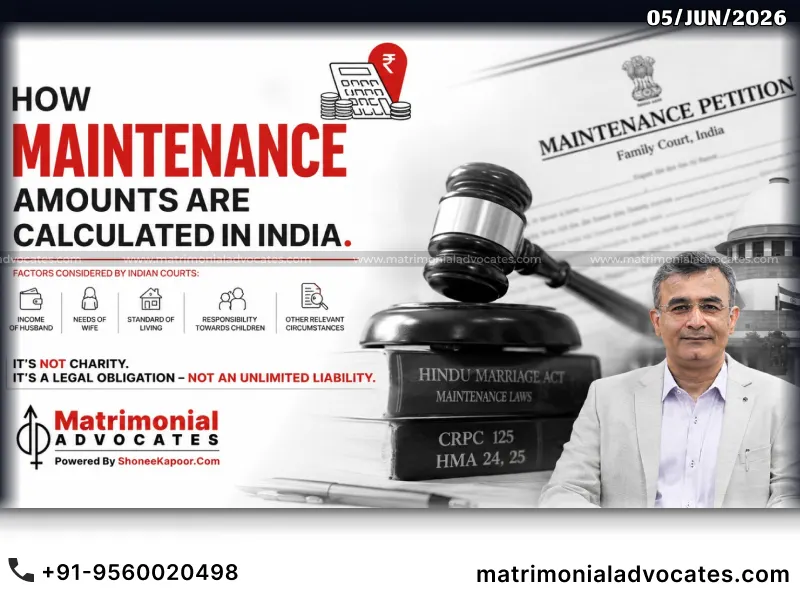
Judicial Approach Adopted by Indian Courts for Determining the Quantum of Maintenance
NEW DELHI: When matrimonial disputes arise, one of the most common questions asked by both husbands and wives is: How do courts calculate maintenance in India?
Many people believe there is a fixed percentage or a predetermined formula that courts apply while determining maintenance. However, Indian law does not prescribe any rigid formula. The amount of maintenance is decided after considering the facts and circumstances of each case, including the income of the parties, their lifestyle, financial responsibilities, assets, liabilities, and the needs of dependent children.
Over the years, the Supreme Court and various High Courts have developed guiding principles to ensure that maintenance is fair, reasonable, and based on actual financial capacity rather than assumptions.
What Is Maintenance Under Indian Law?
Maintenance is a financial support mechanism intended to prevent a spouse, child, or parent from suffering financial hardship. It may be awarded during the pendency of matrimonial proceedings or after the conclusion of the case.
Maintenance can take different forms:
- Interim maintenance during the pendency of proceedings.
- Litigation expenses.
- Permanent alimony after divorce.
- Maintenance for children.
- Maintenance for dependent parents.
The objective is not to punish one party or reward another but to ensure financial security and dignity.
Laws Under Which Maintenance Can Be Claimed
Section 144 of the BNSS, 2023 (Earlier Section 125 CrPC)
This provision provides a quick and summary remedy for wives, children, and parents who are unable to maintain themselves. The purpose is to prevent destitution and vagrancy.
Section 24 of the Hindu Marriage Act, 1955
Section 24 allows either spouse to seek interim maintenance and litigation expenses during the pendency of matrimonial proceedings if he or she lacks sufficient independent income.
Contrary to popular belief, this provision is gender-neutral and can be invoked by either the husband or the wife.
Section 25 of the Hindu Marriage Act, 1955
Section 25 empowers courts to grant permanent alimony and maintenance at the time of passing a decree or subsequently.
The court may award:
- Monthly maintenance.
- Periodical payments.
- Lump-sum alimony.
Hindu Adoptions and Maintenance Act, 1956
This statute governs maintenance rights of wives, children, aged parents, and certain other dependents under Hindu law.
Protection of Women from Domestic Violence Act, 2005
Under the Domestic Violence Act, courts may grant monetary reliefs, including maintenance, in addition to other protections available under the statute.
Is There Any Fixed Formula For Calculating Maintenance?
The simple answer is no.
Indian courts have consistently held that there is no universal formula applicable to every maintenance case. The amount depends upon the facts of each matter.
Although courts occasionally refer to percentages or income benchmarks, these are merely guiding considerations and not mandatory rules.
The Supreme Court has repeatedly emphasized that maintenance must be determined on a case-by-case basis after evaluating all relevant circumstances.
Factors Considered By Courts While Determining Maintenance
Income of the Husband
The court examines the actual earning capacity of the husband, including:
- Salary income.
- Business income.
- Rental income.
- Professional earnings.
- Agricultural income.
- Foreign income.
- Investment returns.
The court may also consider undisclosed income if evidence suggests that the disclosed earnings do not reflect the true financial position.
Income and Financial Status of the Wife
Courts assess:
- Employment status.
- Salary and earnings.
- Educational qualifications.
- Independent assets.
- Investments and savings.
Merely because a wife is educated does not automatically disentitle her from maintenance.
Standard of Living During Marriage
Courts attempt to ensure that the claimant spouse is able to maintain a lifestyle reasonably similar to the one enjoyed during the marriage.
Expenses Relating to Children
Where children are involved, courts consider:
- School fees.
- Tuition expenses.
- Medical costs.
- Extracurricular activities.
- Daily living expenses.
Liabilities and Dependents
The court also examines legitimate financial obligations of the paying spouse, including:
- Maintenance of aged parents.
- Existing loans.
- Medical expenses.
- Other dependent family members.
Assets and Lifestyle
The lifestyle maintained by the parties often becomes an important indicator of their actual financial capacity.
Courts may consider:
- Bank statements.
- Income tax returns.
- Property ownership.
- Vehicles.
- Social media evidence showing lifestyle patterns.
Maintenance In High-Income And NRI Marriages
In disputes involving high-net-worth individuals or NRIs, courts examine:
- Foreign salary records.
- Overseas assets.
- Tax returns.
- International bank accounts.
- Property holdings.
Courts are increasingly scrutinizing attempts to conceal overseas income or understate actual earnings.
The ultimate goal remains the same: determining the true financial capacity of the parties.
Landmark Supreme Court Judgments On Maintenance
Rajnesh v. Neha (2020): This is one of the most important maintenance judgments delivered by the Supreme Court.
The Court issued comprehensive guidelines regarding:
- Disclosure of assets and liabilities.
- Uniform maintenance principles.
- Prevention of multiple maintenance proceedings.
- Standardized affidavits for financial disclosures.
The judgment continues to guide maintenance litigation across India.
Kalyan Dey Chowdhury v. Rita Dey Chowdhury (2017): The Supreme Court observed that in certain circumstances around 25% of the husband’s net salary may be considered reasonable maintenance.
However, the Court did not establish a mandatory formula, and the observation cannot be mechanically applied to every case.
Shamima Farooqui v. Shahid Khan (2015): The Supreme Court held that maintenance should enable a wife to live with dignity and not merely survive.
The Court emphasized that maintenance is not a matter of charity.
Bhuwan Mohan Singh v. Meena (2014): The Supreme Court reiterated that maintenance proceedings are intended to prevent financial deprivation and ensure basic human dignity.
Maintenance Even In Cases Of Void Marriage
The Supreme Court has adopted a progressive approach in certain cases involving void marriages.
The Court has recognized that in appropriate circumstances, financial relief may still be granted to prevent injustice and economic hardship, particularly where one party has suffered because of the relationship.
Such cases are heavily dependent upon their individual facts.
When Can Maintenance Be Reduced, Modified Or Cancelled?
Maintenance orders are not always permanent.
Courts may modify, reduce, or cancel maintenance if there is a substantial change in circumstances, including:
- Remarriage of the recipient spouse.
- Significant increase in the recipient’s income.
- Loss of employment by the paying spouse.
- Concealment of material facts.
- Change in financial circumstances of either party.
Each request for modification is examined on its own merits.
Documents Commonly Considered By Courts
Courts frequently rely upon:
- Salary slips.
- Income tax returns.
- Form 16.
- Bank statements.
- GST records.
- Property documents.
- Investment statements.
- Loan records.
- School fee receipts.
- Medical expense records.
Failure to disclose accurate financial information may adversely affect a party’s case.
CONCLUSION
There is no fixed mathematical formula for calculating maintenance in India. Courts determine the amount after considering the income, assets, liabilities, standard of living, financial responsibilities, earning capacity, and overall circumstances of both parties.
The guiding principle is fairness and financial justice. Maintenance is neither meant to punish one spouse nor provide an unjust enrichment to the other. Its purpose is to ensure that a financially dependent spouse is able to maintain a reasonable standard of living without suffering undue hardship, while also taking into account the paying spouse’s genuine financial obligations and capacity to pay.
Ultimately, every maintenance case is decided on its own facts and evidence. Accurate financial disclosures, documentary proof of income and expenses, and a transparent presentation of financial circumstances often play a decisive role in determining the final amount awarded by the court. A well-prepared case supported by credible evidence can significantly influence the outcome of maintenance proceedings.
FAQs
- Is there a fixed formula for calculating maintenance in India?
No. Indian courts do not follow a fixed formula. The amount is determined based on the facts of each case, including the income, assets, liabilities, needs, and financial responsibilities of both parties. - What factors do courts consider while deciding maintenance?
Courts generally consider the earning capacity of both spouses, their standard of living during the marriage, reasonable expenses, dependents, liabilities, educational qualifications, and overall financial circumstances. - Can an unemployed husband be directed to pay maintenance?
Yes. Courts have repeatedly held that an able-bodied person cannot avoid maintenance obligations merely by remaining unemployed. The court may assess earning capacity rather than actual income alone. - Can a working wife claim maintenance?
Yes. Employment by itself does not automatically disentitle a wife from claiming maintenance. Courts examine whether her income is sufficient to maintain a lifestyle reasonably comparable to that enjoyed during the marriage. - Can the amount of maintenance be increased or reduced later?
Yes. If there is a significant change in circumstances—such as loss of employment, increase in income, remarriage, serious illness, or other material changes—either party may approach the court for modification of the maintenance amount.