Once a marriage was voluntarily registered under the Kerala Registration of Marriages Rules, the registrar cannot cancel the entry merely because the parties later claim their marriage is invalid, the Court said.
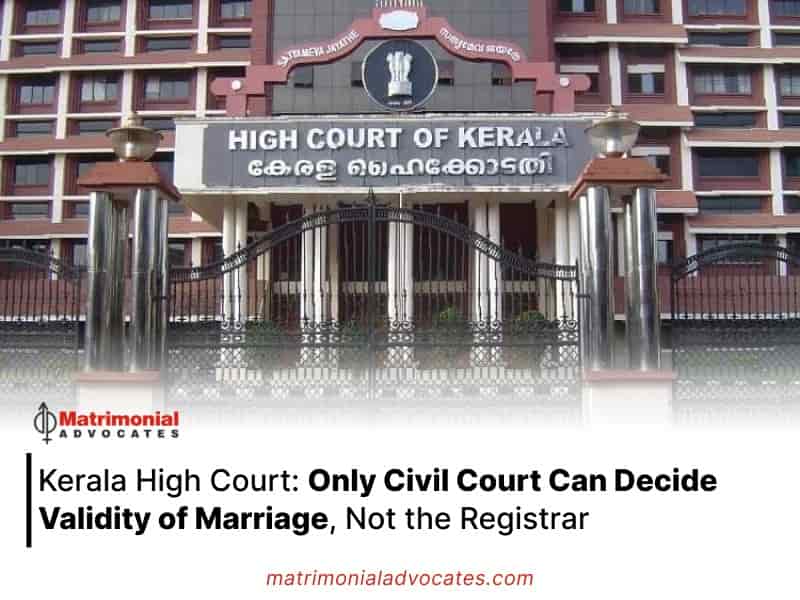
The Kerala High Court recently clarified that marriage registrars are not obligated to resolve disputes regarding the validity of a marriage, as such matters are to be determined by a competent civil court [XXX & Anr. v. State of Kerala & Ors.].
Justice C.S. Dias made this observation while dismissing a joint petition filed by a Muslim man and a Hindu woman seeking the cancellation of their registered marriage certificate on the grounds of invalidity.
The Court held that the issue of the marriage’s validity involves disputed questions of fact, which fall exclusively within the jurisdiction of a civil court, not the marriage registrar.
The Court observed that the registrar’s responsibility is limited to confirming whether the marriage was prima facie solemnised, and does not include assessing its legal validity.
“The Registrar does not have the jurisdiction to adjudicate the above disputed question of fact under Rule 13. The questions regarding the validity of the marriage and the marital status of the parties are to be decided by a competent civil court,” it said.
The Court further stated that since the petitioners had voluntarily affirmed and declared before the local registrar that their marriage was solemnised according to customary rites, they could not later deny or seek to invalidate the registration.
“Having produced documents … and voluntarily testifying that the marriage was solemnised, the petitioners are estopped from reprobating that there is no valid marriage. The Registrar does not have the jurisdiction to adjudicate the above disputed question of fact under Rule 13 (of the Kerala Registration of Marriages Rules),” the Court said.
The petitioners had briefly cohabited in 2014 and, to avoid legal hurdles and social stigma, registered their marriage under the Kerala Registration of Marriages (Common) Rules, 2008.
Later, they separated and jointly applied for cancellation of the marriage certificate, arguing that the marriage lacked legal validity as it was not solemnised under the Special Marriage Act, 1954.
However, the local Registrar denied their request, stating that the law does not provide for the cancellation of a marriage that has been duly registered.
The couple then moved the High Court, challenging the Registrar’s decision. The Court referred to Rule 13 of the 2008 Rules, which allows for cancellation of a marriage certificate only if the entry is shown to be erroneous, fraudulent, or improperly made—and even then, only with the Registrar General’s approval.
The Court emphasised that at the time of registration, the Registrar had relied on the petitioners’ own declarations, a memorandum detailing the date and place of the marriage, and a certificate from a local self-government official who, along with a witness provided by the petitioners, confirmed that the marriage had been solemnised.
Referring to the precedent set in Pranav A.M. v. Secretary, Engandiyur Grama Panchayat (2018 (3) KHC 128), the Court reiterated that the Registrar’s role is confined to being prima facie satisfied that the marriage was solemnised, without examining its legal validity.
Finding no legal flaw in the Registrar’s refusal to cancel the marriage certificate, the Court dismissed the petition. However, it clarified that the petitioners are free to approach a competent civil court if they seek a formal declaration regarding their marital status.