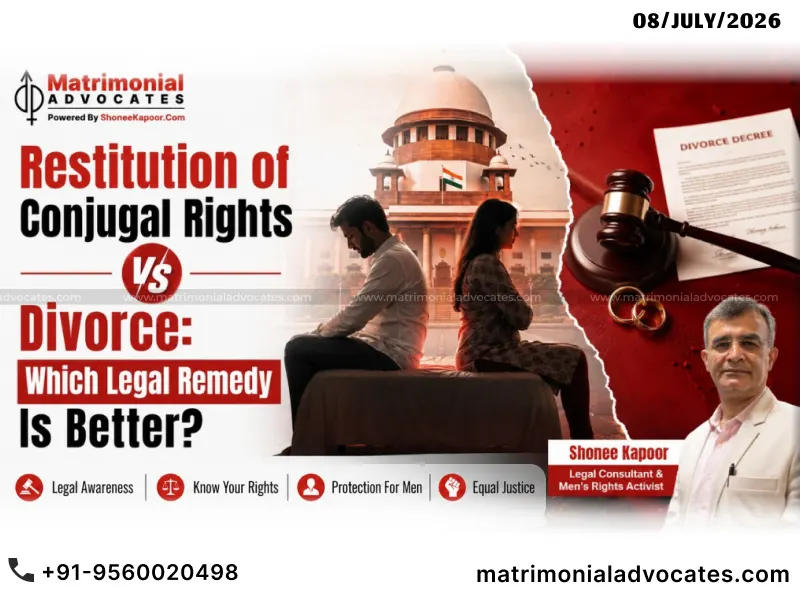
Understanding the legal difference between RCR and divorce proceedings, from preparation of application to mediation, evidence, and obtaining a court decree.
NEW DELHI: Marriage is considered not only a social institution but also a legal relationship that imposes reciprocal rights and obligations on spouses. However, marital disputes, prolonged separation, misunderstandings, or irreconcilable differences often compel spouses to seek legal remedies under matrimonial laws. Two significant remedies available under Indian law are Restitution of Conjugal Rights (RCR) and Divorce.
While Restitution of Conjugal Rights aims to preserve the marital relationship by encouraging spouses to resume cohabitation, divorce legally dissolves the marriage when reconciliation is no longer possible. Choosing between these remedies requires a careful understanding of their objectives, legal implications, and suitability based on the facts of each case.
This article explores the concept of Restitution of Conjugal Rights and Divorce, compares their legal framework, discusses landmark judicial pronouncements, and examines which remedy may be more appropriate in different circumstances.
What is Restitution of Conjugal Rights?
Restitution of Conjugal Rights is a legal remedy that enables an aggrieved spouse to seek a court order directing the other spouse to resume cohabitation when they have withdrawn from the matrimonial relationship without reasonable cause.
The underlying objective of this remedy is to preserve the institution of marriage by encouraging reconciliation instead of dissolution. It reflects the legislative intent that every reasonable effort should be made to save a marriage before ending it permanently.
Unlike divorce, an RCR decree does not dissolve the marriage. Instead, it recognizes the continuing marital relationship and seeks to restore consortium between the spouses.
Legal Provisions Governing RCR
Different personal laws provide for Restitution of Conjugal Rights:
- Section 9 of the Hindu Marriage Act, 1955 – Applicable to Hindus, Buddhists, Jains, and Sikhs.
- Section 22 of the Special Marriage Act, 1954 – Applicable to marriages solemnized under the Special Marriage Act.
- Section 32 of the Indian Divorce Act, 1869 – Applicable to Christians.
Under Muslim law, the remedy of restitution has traditionally been recognized through personal law principles and can be enforced through civil courts.
Essential Ingredients of Section 9, Hindu Marriage Act
To succeed in an RCR petition, the petitioner must establish that:
- There exists a valid marriage.
- The respondent has withdrawn from the petitioner’s society.
- Such withdrawal is without reasonable excuse.
- There is no legal ground for refusing the relief.
Once these elements are established, the burden shifts to the respondent to prove that the withdrawal was justified.
What is Divorce Under Indian Law?
Meaning of Divorce
Divorce is the legal dissolution of a valid marriage through a decree of a competent court. It permanently terminates the marital relationship and releases both spouses from their matrimonial obligations.
Unlike RCR, divorce recognizes that the marriage has broken down beyond repair and that continuation of the marital relationship would serve no useful purpose.
Relevant Legal Provisions
For Hindus, divorce is primarily governed by:
- Section 13 of the Hindu Marriage Act, 1955 – Contested divorce.
- Section 13B – Divorce by mutual consent.
Similarly, the Special Marriage Act, 1954, the Indian Divorce Act, 1869, and personal laws governing Muslims provide separate mechanisms for dissolution of marriage.
Grounds for Restitution of Conjugal Rights
A spouse may seek restitution when the other spouse has withdrawn from the matrimonial relationship without lawful justification.
Examples include:
- Leaving the matrimonial home without valid reason.
- Refusing to cohabit despite repeated requests.
- Desertion without sufficient cause.
However, the respondent may resist an RCR petition by proving:
- Cruelty.
- Domestic violence.
- Adultery.
- Reasonable apprehension of harm.
- Any matrimonial offence committed by the petitioner.
Courts examine whether compelling cohabitation would be fair and consistent with justice.
Grounds for Divorce Under the Hindu Marriage Act
Section 13 of the Hindu Marriage Act provides several grounds for divorce.
Fault-Based Grounds
These include:
- Adultery
- Cruelty
- Desertion for at least two years
- Conversion to another religion
- Mental disorder
- Incurable unsoundness of mind
- Venereal disease (subject to legislative amendments)
- Renunciation of the world
- Presumption of death
In addition, wives enjoy certain special grounds under the Act.
Divorce by Mutual Consent
Section 13B permits spouses to jointly seek divorce if:
- They have lived separately.
- They have mutually agreed that the marriage should be dissolved.
- They are unable to live together.
The Supreme Court has also recognized that the statutory cooling-off period may be waived in appropriate cases where reconciliation is impossible.
Restitution of Conjugal Rights vs Divorce: Key Differences
| Basis | Restitution of Conjugal Rights | Divorce |
| Objective | Restore marital cohabitation | Dissolve marriage |
| Legal Provision | Section 9, Hindu Marriage Act | Sections 13 & 13B, Hindu Marriage Act |
| Nature | Reconciliatory | Dissolution of marriage |
| Marital Status | Marriage continues | Marriage ends |
| Court’s Approach | Encourage reunion | Recognize breakdown of marriage |
| Outcome | Decree directing cohabitation | Decree dissolving marriage |
| Possibility of Reconciliation | High | Generally not applicable |
When Should You Choose Restitution of Conjugal Rights?
RCR may be an appropriate remedy where the marital relationship can still be salvaged.
Situations where RCR may be beneficial include:
- Temporary misunderstandings.
- Family interference causing separation.
- Emotional conflicts capable of resolution.
- One spouse leaving the matrimonial home impulsively.
- The welfare of children requiring preservation of the family unit.
However, courts generally discourage granting such relief where the marital relationship has completely broken down or where cohabitation would expose a spouse to cruelty or abuse.
When Is Divorce a Better Legal Remedy?
Divorce is generally the more appropriate remedy where reconciliation is no longer feasible.
Examples include:
- Persistent physical or mental cruelty.
- Long periods of desertion.
- Adultery.
- Domestic violence.
- Serious incompatibility.
- Repeated failed attempts at reconciliation.
- Irretrievable breakdown of the marital relationship.
Although “irretrievable breakdown of marriage” is not yet a statutory ground under the Hindu Marriage Act, the Supreme Court has exercised its extraordinary powers under Article 142 of the Constitution to grant divorce in deserving cases.
Can Non-Compliance with an RCR Decree Lead to Divorce?
Yes. Under Section 13(1A) of the Hindu Marriage Act, either spouse may seek divorce if there has been no resumption of cohabitation for one year or more after the passing of a decree for Restitution of Conjugal Rights.
Thus, an unsuccessful attempt at reconciliation through RCR may eventually become a statutory ground for divorce.
Procedure for Filing Restitution of Conjugal Rights
The general procedure includes:
- Consultation with a family law advocate.
- Preparation of the petition.
- Filing before the competent Family Court.
- Issuance of notice to the respondent.
- Filing of written statement.
- Mediation or reconciliation efforts.
- Recording of evidence.
- Final hearing.
- Judgment and decree.
Procedure for Filing Divorce
Contested Divorce
The process usually involves:
- Filing of the divorce petition.
- Service of summons.
- Written statement.
- Framing of issues.
- Evidence by both parties.
- Final arguments.
- Judgment.
Mutual Consent Divorce
The process includes:
- Joint petition.
- Recording of the First Motion.
- Cooling-off period (where applicable).
- Second Motion.
- Decree of divorce.
Landmark Case Laws on Restitution of Conjugal Rights
- Sareetha v. T. Venkata Subbaiah (1983)
The Andhra Pradesh High Court held that Section 9 violated the constitutional right to privacy and personal liberty under Article 21.
Although significant, this view was later overruled.
Harvinder Kaur v. Harmander Singh Choudhry (1984)
The Delhi High Court upheld the constitutional validity of Section 9, observing that marriage creates mutual obligations and that the provision promotes reconciliation rather than coercion.
Saroj Rani v. Sudarshan Kumar Chadha (1984) 4 SCC 90
The Supreme Court settled the controversy by upholding the constitutional validity of Section 9 of the Hindu Marriage Act.
The Court observed that the primary purpose of Restitution of Conjugal Rights is to preserve the institution of marriage and facilitate reconciliation between spouses rather than compel forced cohabitation.
This remains the leading authority on the validity of Section 9.
Landmark Divorce Cases
Naveen Kohli v. Neelu Kohli (2006) 4 SCC 558
The Supreme Court recommended that Parliament consider introducing “irretrievable breakdown of marriage” as an independent ground for divorce, recognizing that forcing parties to remain in a dead marriage often serves no useful purpose.
Samar Ghosh v. Jaya Ghosh (2007) 4 SCC 511
The Court laid down comprehensive principles for determining what constitutes mental cruelty under matrimonial law. The judgment continues to guide courts in deciding cruelty-based divorce petitions.
- Bhagat v. D. Bhagat (1994) 1 SCC 337
The Supreme Court expanded the scope of mental cruelty and held that conduct causing deep mental pain, agony, or suffering may justify dissolution of marriage.
Shilpa Sailesh v. Varun Sreenivasan (2023)
The Supreme Court held that it may exercise its powers under Article 142 of the Constitution to dissolve marriages that have irretrievably broken down, even if the statutory grounds are not strictly fulfilled.
Advantages and Disadvantages of Restitution of Conjugal Rights
Advantages
- Promotes reconciliation.
- Encourages preservation of marriage.
- Protects children’s interests.
- Less adversarial than divorce.
- May prevent unnecessary dissolution.
Disadvantages
- Difficult to enforce practically.
- May prolong an unhappy marriage.
- Alleged interference with privacy.
- Sometimes used strategically in matrimonial litigation.
Advantages and Disadvantages of Divorce
Advantages
- Provides legal closure.
- Ends abusive relationships.
- Enables parties to rebuild their lives.
- Facilitates permanent settlement of matrimonial disputes.
Disadvantages
- Emotional trauma.
- Financial burden.
- Child custody disputes.
- Lengthy litigation in contested cases.
Practical Considerations Before Choosing Between RCR and Divorce
Before initiating legal proceedings, spouses should consider:
- Whether reconciliation is genuinely possible.
- Nature and seriousness of matrimonial disputes.
- Presence of cruelty or domestic violence.
- Duration of separation.
- Welfare of children.
- Financial implications.
- Emotional well-being.
- Time and costs involved in litigation.
Seeking professional legal advice and exploring mediation at an early stage may often help resolve disputes more effectively than prolonged litigation.
CONCLUSION
Restitution of Conjugal Rights and Divorce serve distinct purposes within Indian matrimonial law. While the one seeks to preserve and restore the marital relationship, the another recognizes that some marriages have irretrievably failed and require legal dissolution. Neither remedy is inherently superior; the appropriate choice depends on the specific facts, the possibility of reconciliation, the presence of cruelty or abuse, and the long-term welfare of the spouses and their children.
Courts consistently emphasize that marriage should be preserved where genuine reconciliation is possible. However, where the relationship has become oppressive, abusive, or beyond repair, divorce may offer the most effective path toward justice and closure. Individuals facing matrimonial disputes should carefully evaluate their legal rights, explore mediation where appropriate, and seek informed legal advice before deciding which remedy best serves their interests.
FAQs
- Can a wife file a petition for Restitution of Conjugal Rights?
Yes. Both husband and wife have an equal right to seek relief under Section 9 of the Hindu Marriage Act.
- Is filing an RCR petition mandatory before seeking divorce?
No. Divorce can be sought directly if statutory grounds exist.
- Can maintenance be claimed during RCR proceedings?
Yes. Depending on the circumstances, maintenance may be claimed under the applicable provisions of matrimonial and maintenance laws.
- Can the court force spouses to live together?
No. Courts cannot compel physical cohabitation. An RCR decree is enforced through civil legal consequences rather than physical coercion.
- Can failure to comply with an RCR decree become a ground for divorce?
Yes. Under Section 13(1A) of the Hindu Marriage Act, non-resumption of cohabitation for one year after the decree may constitute a ground for divorce.