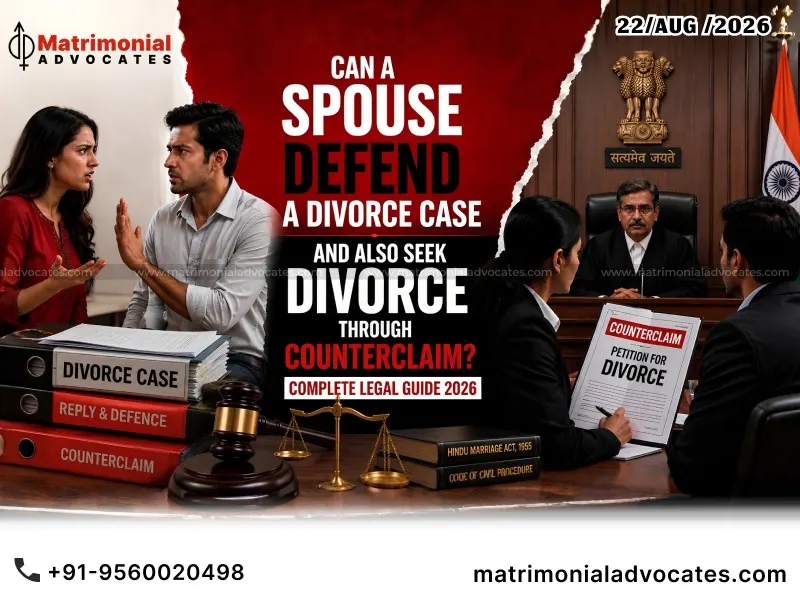
How Section 23A HMA Allows A Spouse To Defend A Divorce Petition And Seek Independent Matrimonial Relief Through Counterclaim
NEW DELHI: A divorce petition does not always leave the respondent with only one option: defending the allegations made against him or her.
In some cases, the respondent may deny the allegations in the divorce petition but also have independent grounds to seek dissolution of the marriage. Indian matrimonial law recognises this situation and, in appropriate cases, permits the respondent to seek relief through a counterclaim in the same matrimonial proceeding.
Under Section 23A of the Hindu Marriage Act, 1955, a respondent in proceedings for divorce, judicial separation or restitution of conjugal rights may oppose the relief claimed by the petitioner and also make a counterclaim for relief under the Act on the ground of the petitioner’s adultery, cruelty or desertion.
This has an important practical consequence. If a husband merely succeeds in disproving the wife’s allegations and gets her divorce petition dismissed, the marriage does not automatically come to an end. If he independently wants a decree of divorce on legally sustainable grounds, he must seek that relief before the court.
A defence is therefore aimed at defeating the petitioner’s case, while a counterclaim enables the respondent to seek independent matrimonial relief in his or her own favour.
For spouses involved in contested divorce litigation, understanding this distinction at the start of the case can significantly affect how the pleadings, evidence, and overall litigation strategy are framed.
DEFENCE AND COUNTERCLAIM ARE NOT THE SAME THING
A defence and a counterclaim serve two different purposes in a divorce proceeding.
If a wife files for divorce alleging cruelty, the husband may file a written statement denying those allegations and asking the Family Court to dismiss her petition. This is his defence to the case filed against him.
However, if the husband also alleges that the wife’s own conduct amounts to legally recognised cruelty and independently seeks dissolution of the marriage on that ground, he is seeking affirmative relief through a counterclaim.
The distinction is important.
If the husband only succeeds in defending the wife’s petition, the court may dismiss her divorce case, but the marriage will ordinarily continue.
If he also files and proves a legally maintainable counterclaim for divorce, the court can separately examine whether he is entitled to a decree of divorce in his own favour.
In short, a defence seeks rejection of the petitioner’s relief, while a counterclaim seeks independent matrimonial relief for the respondent.
SECTION 23A HMA: THE LEGAL FOUNDATION
Section 23A of the Hindu Marriage Act was designed precisely to enable certain counter-relief in matrimonial proceedings.
It applies where the original proceeding is for:
- divorce;
- judicial separation; or
- restitution of conjugal rights.
The provision specifically refers to the petitioner’s adultery, cruelty or desertion as grounds on which the respondent may oppose the claim and seek relief under the Act.
Further, Section 21 HMA makes the Code of Civil Procedure applicable to proceedings under the Hindu Marriage Act, subject to the provisions of the Act and applicable rules.
The matrimonial counterclaim therefore operates within a specialised statutory framework. It should not be treated exactly like an ordinary commercial recovery counterclaim.
WHAT CAN YOU ASK FOR THROUGH A COUNTERCLAIM?
The Supreme Court clarified an important limitation in Nitaben Dinesh Patel v. Dinesh Dahyabhai Patel, decided on 7 October 2021.
The Court explained that relief claimed under Section 23A HMA must be relief available under the Hindu Marriage Act itself.
Accordingly, depending upon the pleadings and statutory requirements, relief may concern matrimonial remedies under provisions dealing with matters such as restitution of conjugal rights, judicial separation, nullity or divorce.
But Section 23A cannot be used as a vehicle for every dispute between spouses.
In Nitaben, the Supreme Court made it clear that the counterclaim could not be used to obtain relief against third parties merely because those allegations arose out of the matrimonial dispute.
The Karnataka High Court applied the same principle in Mahadevashetty v. Prathima V. in 2024. A monetary claim of approximately ₹15.97 lakh relating to alleged expenditure on construction could not be pursued as matrimonial relief under Section 23A merely because a divorce case was pending.
The lesson is simple: a matrimonial counterclaim must seek matrimonial relief that the law permits. Property recovery, damages or other independent civil claims may require separate substantive proceedings.
WHAT THE COURTS ACTUALLY DID
The practical importance of counterclaims becomes clearer from what has happened in actual court proceedings.
In Nitaben, the wife sought to introduce a counterclaim after filing her written statement. Her counsel argued that relevant facts concerning the husband’s subsequent marriage came to light during cross-examination when documentary material surfaced.
The Supreme Court held that the High Court was not justified in rejecting the proposed counterclaim merely because the written statement had already been filed. At the same time, the Court limited the permissible relief to what the Hindu Marriage Act provided and refused relief against third parties.
In Smt. Hemavathy K. v. N. Ashok Kumar, the husband had filed a petition for restitution of conjugal rights. The wife opposed it and made a counterclaim seeking divorce on grounds including cruelty and desertion.
The husband later withdrew his original petition.
The Karnataka High Court held that the wife’s counterclaim did not automatically disappear merely because the husband withdrew his case. It directed that the counterclaim be dealt with independently.
In substance, the petitioner cannot necessarily destroy a properly instituted counterclaim simply by withdrawing the original matrimonial proceeding.
The Allahabad High Court followed the same procedural principle in Ishita Dua v. Tarun Kumar Sharma in 2024, observing that a counterclaim can survive withdrawal or discontinuance of the original claim under the CPC framework.
MERELY MAKING ALLEGATIONS IS NOT ENOUGH
A particularly useful warning came from the Allahabad High Court in Dr. Madhu Singh Chaudhary v. Dr. Atul Bharti, decided on 7 October 2025.
The wife was defending the husband’s divorce case and alleged that the husband was involved in an adulterous relationship.
The High Court observed that such an allegation, if legally established, could have supplied a ground for her to seek dissolution of marriage.
But she had neither instituted her own divorce proceedings nor filed a counterclaim seeking that relief.
The allegation therefore could not simply be converted into her own divorce decree in the husband’s proceeding.
This distinction should not be ignored:
Pleading misconduct as a defence is not automatically the same as asking the court for affirmative matrimonial relief.
WHEN SHOULD THE COUNTERCLAIM BE FILED?
As a matter of litigation strategy, the safest course is to raise the counterclaim with the written statement when the cause of action already exists, and the necessary facts are known.
However, matrimonial proceedings are not always that mechanically rigid.
In Ruchi v. Bhanupratapsingh, the Bombay High Court held that the ordinary restriction under Order VIII Rule 6A CPC could not simply be applied in a manner that defeats the special scheme of Section 23A HMA.
The Supreme Court’s decision in Nitaben also shows that where a relevant cause or material fact emerges later during the proceedings, the mere fact that a written statement has already been filed is not by itself an absolute answer.
That does not mean a counterclaim can be introduced casually at any stage.
Delay, amendment, prejudice to the opposite party, the stage of trial and when the cause arose can all matter. A respondent who already knows that he wants affirmative matrimonial relief should ordinarily plead it at the earliest proper stage.
WHY THIS MATTERS PARTICULARLY FOR HUSBANDS
In contested matrimonial cases, husbands are frequently forced into a purely defensive mindset: deny the allegations, fight maintenance litigation, contest criminal accusations where applicable and somehow survive the divorce trial.
But there is a basic litigation question that should be asked at the beginning:
Do you merely want her divorce petition dismissed, or do you independently want the marriage dissolved on grounds available to you?
These are not the same objective.
If a husband’s case is that he has himself suffered legally recognised matrimonial cruelty or desertion, spending years only proving that he was not the wrongdoer may still leave him married at the end of the litigation if he never sought his own relief.
A Family Court decides prayers placed before it according to law. It does not ordinarily manufacture a divorce claim for a spouse who never sought one.
Defence protects you against the other side’s decree. A counterclaim can pursue your own decree.
That is why counterclaims remain one of the most underused strategic tools in contested matrimonial litigation.
DOES THE SAME RULE APPLY TO EVERY MARRIAGE?
No. The applicable personal or matrimonial law must first be identified.
For marriages governed by the Hindu Marriage Act, Section 23A is the principal provision discussed above.
For marriages governed by the Special Marriage Act, 1954, Section 35 contains a substantially similar provision permitting a respondent to oppose the petitioner’s claim and make a counterclaim for relief under that Act in the circumstances specified there.
The Parsi Marriage and Divorce Act, 1936 also contains a statutory counterclaim provision in Section 37.
The Divorce Act, 1869 contains its own framework concerning relief available to a respondent in matrimonial proceedings.
Therefore, do not copy-paste Section 23A HMA into every matrimonial case. The marriage statute, relief claimed, grounds pleaded and procedural stage must all be examined first.
CONCLUSION
In appropriate cases, a spouse can contest the divorce petition filed against them and also seek divorce through a counterclaim under the applicable matrimonial law.
Under Section 23A of the Hindu Marriage Act, 1955, the respondent may oppose the petitioner’s claim while also seeking independent matrimonial relief on legally recognised grounds such as adultery, cruelty or desertion.
This distinction is important because dismissal of the other spouse’s divorce petition does not automatically dissolve the marriage. If the respondent also wants a decree of divorce, that relief must be specifically claimed, properly pleaded and proved before the court.
For husbands facing contested matrimonial litigation, the strategy should therefore be clear from the outset: Are you only defending the case, or are you also seeking an independent decree of divorce?
A properly framed counterclaim can allow both issues to be adjudicated in the same matrimonial proceeding and may avoid the need for separate litigation.
FAQs
- Can I oppose my spouse’s divorce petition and still ask for divorce?
Yes. Where Section 23A HMA applies, the respondent may defend the original proceeding and also make a legally maintainable counterclaim for matrimonial relief. - Do I always need to file a separate divorce petition?
No. A proper counterclaim may allow the respondent to seek matrimonial relief in the existing proceeding, depending on the statute and facts. - What happens if the spouse who filed the case withdraws it?
A properly instituted counterclaim may survive withdrawal of the original petition and can be adjudicated independently. - Can a divorce counterclaim be filed after the written statement?
In appropriate circumstances, yes. Courts have permitted later counterclaims, particularly where the relevant cause or facts arose or became known subsequently. Delay should still be properly explained. - Can I claim property or recover money through Section 23A HMA?
Not merely because a divorce case is pending. Section 23A is limited to relief under the Hindu Marriage Act; separate monetary or property claims may require separate proceedings.