

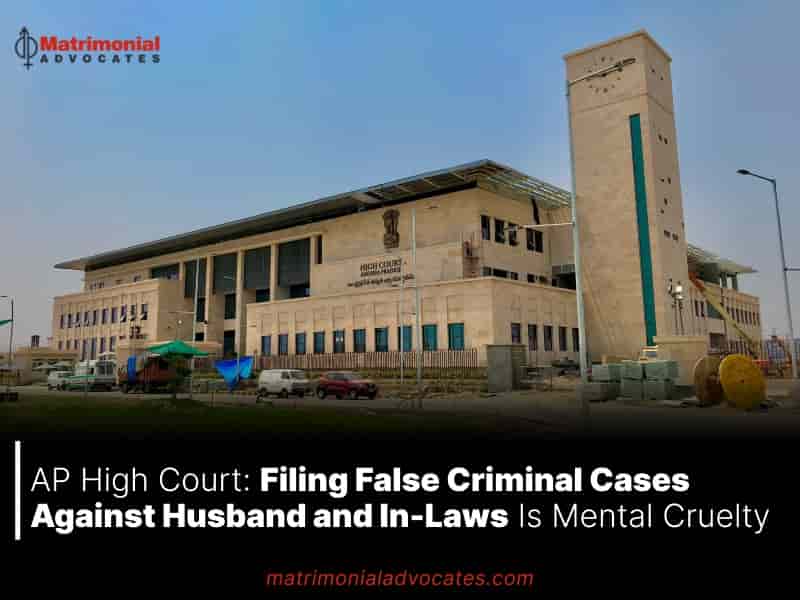
The Andhra Pradesh High Court dismissed an Appeal of a wife against the Decree of Divorce passed by the Principal Senior Civil Judge under Section 13(1)(ia)(ib) of the Hindu Marriage Act, 1955.
The Andhra Pradesh High Court held that filing criminal cases with the intent to harass, defame, and imprison the husband and his family amounts to mental cruelty under Section 13(1)(ia) of the Hindu Marriage Act, 1955.
This observation was made while hearing an appeal filed by the wife challenging a divorce decree granted by the Principal Senior Civil Judge under Sections 13(1)(ia) and 13(1)(ib) of the Act.
A Division Bench of Justice Ravi Nath Tilhari and Justice Challa Gunaranjan observed, “Mental cruelty cause much serious injury than physical harm. The criminal cases filed by wife to embarrass and incarcerate the husband and his family members cause persistent trauma, humiliation in social circle which amount to mental cruelty under Section 13(1)(ia) of H.M.Act, and particularly when in reality they are not guilty and so acquitted. Such can only be imagined by others.”
The Bench clarified that because mental cruelty is difficult to establish with direct evidence, the standard of proof applied is the preponderance of probabilities, as opposed to the stricter requirement of proof beyond reasonable doubt used in criminal cases.
Factual Background
The respondent-husband stated that the appellant was his lawfully wedded wife, and their marriage had been solemnized in 1994 in accordance with Hindu rites, caste, and customs. At the time, he was employed as a lecturer at a coaching centre, while the wife, a graduate, was residing with her parents. The marriage was reportedly conducted without any demand for dowry. However, merely three days after the wedding, the wife allegedly revealed that the marriage had taken place against her will. It was further claimed that she began exhibiting unusual behavior and soon left for Tirupati under the pretext of work-related obligations. Although she returned to the matrimonial home briefly on a few occasions, her conduct reportedly caused the husband considerable distress and mental agony.
The couple never cohabited, and the wife was alleged to have neglected even the fundamental responsibilities expected of a spouse. The husband narrated several instances that, according to him, caused severe mental anguish and amounted to cruelty. Efforts by family elders to mediate the dispute reportedly failed, as the wife is said to have demanded a substantial sum of money. Consequently, the husband felt compelled to file for divorce. In response, the wife filed a counterclaim denying the allegations of cruelty, instead accusing the husband of accepting dowry and making repeated demands for more, along with subjecting her to harassment and ill-treatment. After evaluating the evidence, the trial court concluded that the relationship had irretrievably broken down and granted a decree of divorce in the husband’s favor. Dissatisfied with this outcome, the wife appealed the decision before the High Court.
Reasoning
The High Court in view of the facts and circumstances of the case, said, “… the mental cruelty is a state of mind, the feeling of deep anguish, disappointment, frustration in one spouse caused by the conduct of other. The ill-conduct must be persistent for a fairly lengthy period, where the relationship has deteriorated to an extent that because of the acts and behaviour of a spouse, the wronged party finds it extremely difficult to live with the other party any longer.”
The Court noted that the wife’s act of lodging a criminal complaint under Section 498-A of the Indian Penal Code, 1860, against the husband and his parents—who were forced to obtain bail and were later acquitted for lack of evidence—constituted behavior that inflicted mental cruelty and distress upon the husband.
“It amounted to mental cruelty and furnished a ground for divorce under Section 13(1)(ia) of the H.M.Act. … Additionally, the parties are living for the last 29 years separately and before that they lived together for short period as is clear from the pleadings of the parties”, it added.
The Court further observed that while the wife had submitted an affidavit expressing her willingness to resume cohabitation, the husband, in his own affidavit, asserted that she had subjected him and his parents to harassment by filing a false criminal complaint. Although they were ultimately acquitted, the experience had caused considerable mental anguish to him and his entire family.
“The parties are living separately for last 29 years and there is no chance for reunion. In his evidence also as P.W.1, the husband deposed to that effect that in view of false implication in criminal case, reunion is not possible. Considering the facts and circumstances of the case and also the period of long separation coupled with the affidavit of the husband. We are in agreement with the view taken by the learned trial court that now it is not possible for the parties to lead a matrimonial life together”, it observed.
The Court concluded that, having established the ground of cruelty, reversing the divorce decree would only intensify the hardship faced by both parties.
“The relationship is beyond repair. The marriage has become a fiction. … In view of the above considerations, we hold on Point-A that the ground of ‘cruelty’ under Section 13(1)(ia) of H.M.Act was established to grant divorce. We hold on Point No.B that there is no illegality in the decree of divorce granted by the learned Trial Court. The same calls for no interference and is affirmed”, it also remarked.
Consequently, the High Court rejected the appeal and upheld the divorce decree.