

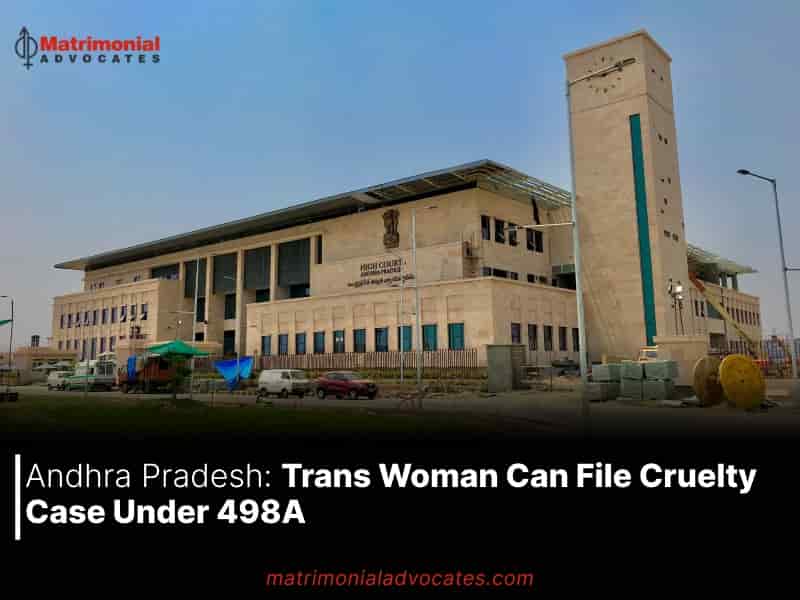
To deny a trans woman the status of a ‘woman’ for the purpose of legal protection under Section 498A IPC solely on the ground of her reproductive capacity is to perpetuate discrimination, the Court ruled.
The Andhra Pradesh High Court has held that a trans woman in a heterosexual marriage has the right to file a cruelty complaint under Section 498A of the Indian Penal Code (IPC), which penalizes cruelty by a husband or his relatives.
The ruling came in the case Viswanathan Krishna Murthy vs. State of Andhra Pradesh & Another. Justice Venkata Jyothirmai Pratapa was hearing a plea to quash charges under Section 498A IPC and Section 4 of the Dowry Prohibition Act, filed by a trans woman—assigned male at birth—against her husband and his family.
“This Court makes it clear that, a transwoman, who is a transgender, being in heterosexual marriage, shall have protection under Section 498-A IPC,” the single-judge ruled.
The petitioners contended that a trans woman could not file a complaint under Section 498A IPC against her husband or in-laws, claiming she does not fully qualify as a “woman.”
Rejecting this, the Court ruled that denying womanhood on the basis of reproductive capacity is both flawed and legally unsustainable.
The Court emphasized that defining womanhood solely through the lens of reproduction violates the Constitution’s core values of dignity, identity, and equality for all, regardless of gender identity.
“To deny a trans woman the status of a ‘woman’ for the purpose of legal protection under Section 498-A IPC solely on the ground of her reproductive capacity is to perpetuate discrimination and to violate Articles 14, 15, and 21 of the Constitution. Such a contention, therefore, deserves to be rejected at the outset,” it added.
In this context, the Court cited the Supreme Court’s decision in Supriyo vs Union of India, where the apex court declined to recognize same-sex marriages.
“It is pertinent to note that despite denying legal validity to same-sex marriage, the Court unanimously directed the Union government to form a high-level committee under the Cabinet Secretary to examine and recommend measures ensuring equal rights for queer couples in areas such as adoption, healthcare, succession, pensions, and financial services. The Hon’ble Court’s clarification that transgender individuals in heterosexual relationships have the right to marry under the existing legal framework strikes at the very argument raised by the learned counsel for the Petitioners in the case on hand, who placed reliance on the said decision,” the High Court said.
Assessing the case on its merits, the Court observed that the accused-husband was aware of the complainant’s identity as a trans woman. It noted that he had expressed love for her, cohabited with her for a period, and eventually married her at an Arya Samaj Mandir. The Court also found that the complaint lacked any specific allegations indicating cruelty by the accused.
“The only allegation against Accused No.1 is that, he left to his parents‟ house on 13.03.2019 and did not return to her. Further, she stated in her complaint that, on 27.04.2019 she received a message from the mobile of Accused No.1 cautioning her to go back otherwise, she would be killed. Further, except stating that at the time of marriage, the parents of Respondent No.2 gave dowry and gold and silver articles to Accused No.1, there is no iota of material to buttress the said allegation,” it said.
The Court concluded that, aside from vague and generalized allegations against the petitioners, no prima facie case was established. Accordingly, it decided to quash the proceedings against the accused.
“The criminal proceedings against the Petitioners/Accused Nos.1 to 4 in C.C.No.585 of 2022 on the file of the Court of II Additional Munsif Magistrate, Ongole for the offences under Section 498-A read with 34 IPC and Section 4 of the D.P. Act, are hereby quashed,” it ordered.