

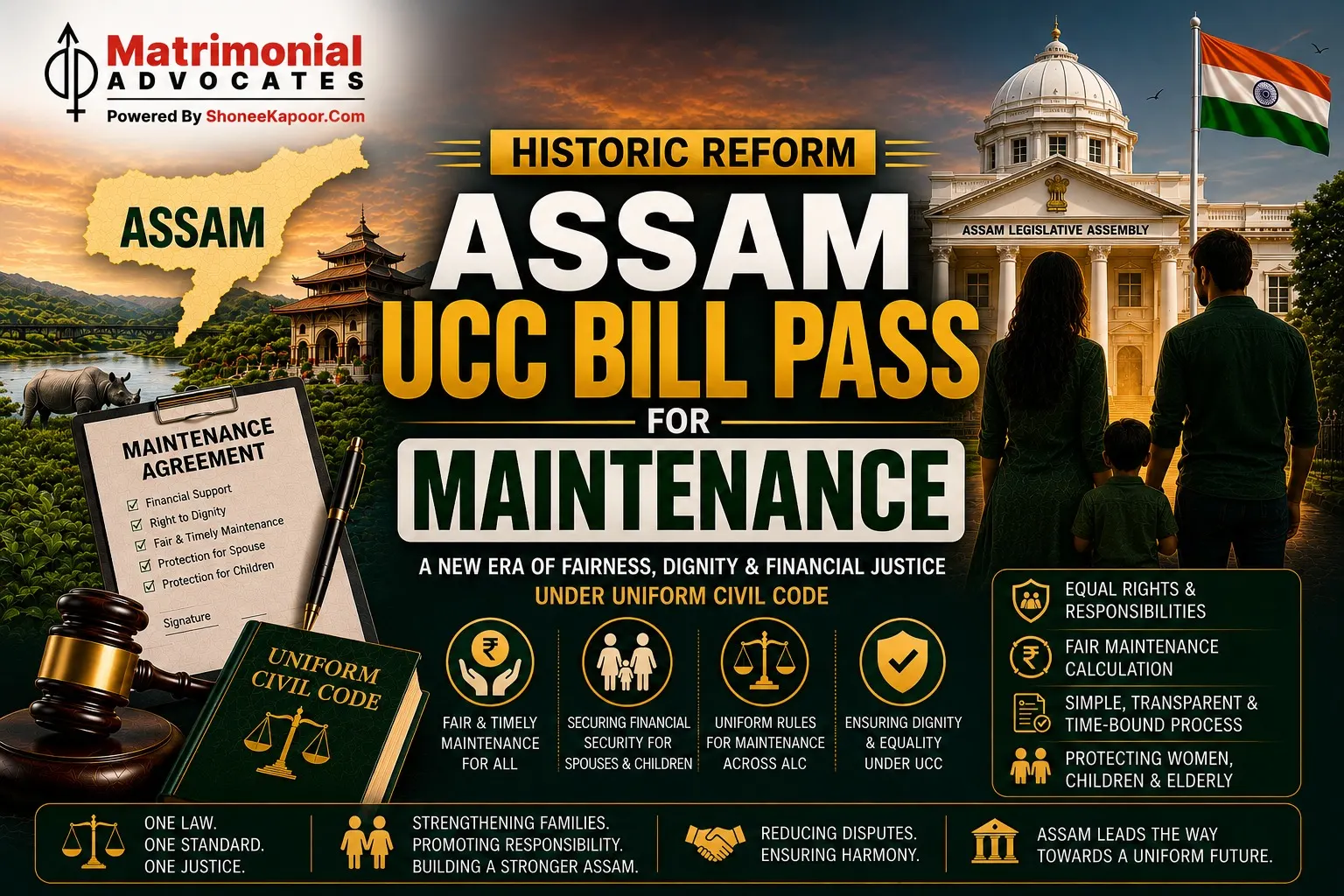
Assam UCC Bill Pass For Maintenance: Complete Guide to Maintenance Under Assam Uniform Civil Code, 2026
The Assam Uniform Civil Code (UCC) Bill, 2026 has been passed by the Assam Legislative Assembly, making Assam the third Indian state, after Uttarakhand and Gujarat, to enact a Uniform Civil Code. The legislation introduces a uniform legal framework governing marriage, divorce, maintenance, succession, inheritance, and live-in relationships for persons covered by the Code, while exempting Scheduled Tribes from its application.
One of the major objectives of the Assam UCC Bill Pass For Maintenance is to establish uniform maintenance provisions, replacing religion-based personal law standards with a common legal framework. The Code empowers courts to grant financial support to eligible dependents while ensuring fairness, gender justice, and financial security.
What is Maintenance Under the Assam UCC?
Maintenance refers to financial support that a competent court may order one person to provide to another who is legally entitled to such support.
Maintenance may include:
- Food and nutrition
- Clothing
- Residence
- Medical expenses
- Educational expenses
- Daily living expenses
- Other reasonable necessities
The court determines maintenance after considering the financial condition and circumstances of the parties.
Who Can Claim Maintenance?
Depending upon the facts of each case and the provisions of the Assam UCC, maintenance may be claimed by:
- Wife
- Husband (where legally permissible)
- Minor children
- Dependent children
- Other eligible dependents recognized under the Code
The court examines both the legal entitlement and financial needs before granting maintenance.
Interim Maintenance
During the pendency of matrimonial proceedings, the court may grant interim maintenance to ensure that the financially weaker party can:
- Meet day-to-day living expenses.
- Continue legal proceedings.
- Maintain a reasonable standard of living until the case is finally decided.
The court may also award litigation expenses where appropriate.
Permanent Maintenance
After divorce or the conclusion of matrimonial proceedings, the court may award permanent maintenance.
While determining the amount, the court may consider:
- Income of both spouses.
- Property and assets.
- Financial liabilities.
- Standard of living during marriage.
- Age and health.
- Employment and earning capacity.
- Needs of dependent children.
- Other relevant circumstances.
Every maintenance order is based on the individual facts and evidence presented before the court.
Child Maintenance
The Assam UCC empowers courts to make suitable orders regarding the maintenance of children.
Child maintenance may include:
- School fees.
- College expenses.
- Medical treatment.
- Food and nutrition.
- Clothing.
- Accommodation.
- Educational materials.
- Other necessary expenses.
The best interests and welfare of the child remain the foremost consideration while determining maintenance.
Maintenance in Registered Live-in Relationships
The Assam UCC introduces legal protection for eligible registered live-in relationships.
Where an eligible registered live-in partner is deserted without financial support, the affected partner may approach the competent court to seek maintenance in accordance with the provisions of the Code. This represents an important legal safeguard introduced by the Assam UCC.
Factors Considered by the Court
Before granting maintenance, the court may consider:
- Monthly income of both parties.
- Employment status.
- Property and assets.
- Financial liabilities.
- Health conditions.
- Standard of living.
- Number of dependents.
- Educational needs of children.
- Other relevant circumstances.
The objective is to ensure that the maintenance awarded is fair, reasonable, and proportionate.
Modification of Maintenance Orders
Maintenance orders are not necessarily permanent.
The competent court may modify an existing maintenance order if there is a significant change in circumstances, including:
- Increase or decrease in income.
- Loss of employment.
- Serious illness.
- Change in financial responsibilities.
- Remarriage, where legally relevant.
- Other material changes affecting either party.
The modification must be made through the competent court.
Enforcement of Maintenance Orders
If a person fails to comply with a maintenance order, the competent court may initiate appropriate legal proceedings to enforce the order in accordance with the provisions of the Assam UCC and applicable procedural laws.
Failure to obey maintenance orders may result in legal consequences as provided under the law.
Equal Rights Under the Assam UCC
One of the major objectives of the Assam UCC is to provide equal legal protection irrespective of religion for persons covered by the Code.
The maintenance provisions are intended to:
- Promote gender justice.
- Protect financially dependent spouses.
- Secure the welfare of children.
- Create uniform legal standards.
- Reduce inequalities arising from different personal laws.
Key Features of Assam UCC Maintenance Law
- Uniform maintenance provisions.
- Interim and permanent maintenance.
- Child maintenance.
- Maintenance rights in eligible registered live-in relationships.
- Financial support based on individual circumstances.
- Courts consider income, property, liabilities, and needs.
- Maintenance orders can be modified when circumstances change.
- Uniform legal framework irrespective of religion (subject to statutory exemptions).
How Assam UCC Differs from Earlier Personal Laws
Before the Assam UCC, maintenance rights varied according to different personal laws applicable to different religious communities.
The Assam UCC establishes:
- A common maintenance framework.
- Equal legal standards.
- Uniform court procedures.
- Protection for spouses and children.
- Recognition of maintenance rights in eligible registered live-in relationships.
These reforms aim to provide greater consistency and legal certainty in family law disputes.
FAQs
- Is the Assam UCC Bill passed?
Yes. The Assam Legislative Assembly passed the Assam Uniform Civil Code Bill, 2026, making Assam the third Indian state after Uttarakhand and Gujarat to enact a Uniform Civil Code. - What does maintenance include under the Assam UCC?
Maintenance generally includes food, clothing, residence, medical expenses, educational expenses, and other reasonable living costs as determined by the competent court. - Can children receive maintenance?
Yes. The court may grant maintenance covering education, healthcare, accommodation, food, clothing, and other essential expenses for children. - Can a registered live-in partner claim maintenance?
Yes. An eligible registered live-in partner who is deserted may seek maintenance under the provisions of the Assam UCC. - Can maintenance orders be modified?
Yes. Courts may increase, reduce, or otherwise modify maintenance orders where there is a substantial change in the financial or personal circumstances of the parties.
Conclusion
The Assam UCC Bill Pass For Maintenance introduces a modern and uniform system of financial support for spouses, children, and eligible partners in registered live-in relationships. By empowering courts to award interim maintenance, permanent maintenance, child support, and maintenance in qualifying live-in relationships, the Assam Uniform Civil Code seeks to promote equality, protect financially dependent family members, and establish a consistent legal framework for maintenance disputes across the state.