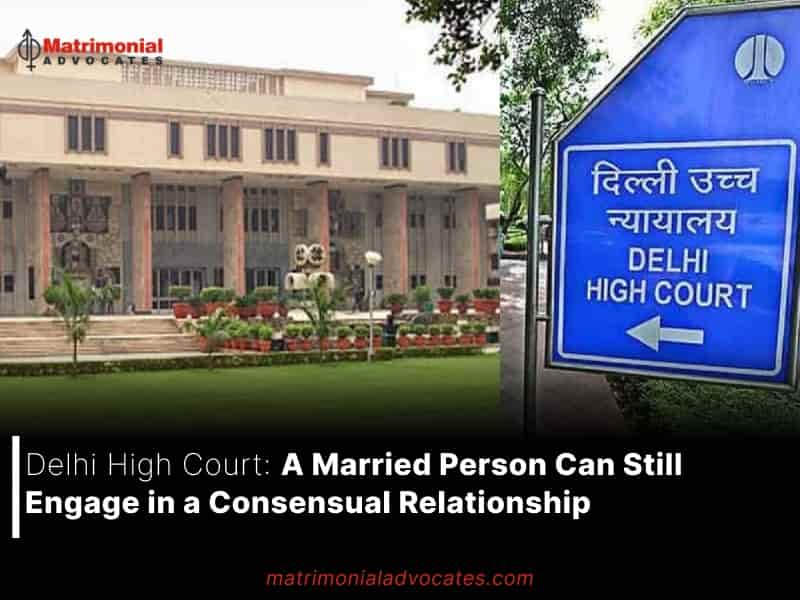
The Delhi High Court observed that relationships between consenting adults, even if one of them is married, should not be evaluated through outdated notions.
Justice Swarana Kanta Sharma remarked that when two adults decide to cohabit or engage in a sexual relationship, they are accountable for the consequences of their choice. However, judges cannot allow their personal moral beliefs to influence such issues. The Court further highlighted that in contemporary times, educated adults view relationships differently from how they were traditionally perceived.
It was further emphasized that the justice system must address such matters with a non-judgmental approach, while also recognizing the responsibilities that naturally flow from the decisions made by adults.
The Court observed that when an educated woman knowingly enters into a relationship with a married man, she must be prepared to face the consequences of that choice.
It further noted that she should recognize the possibility that such a relationship may not culminate in marriage or might ultimately break down, emphasizing that the law cannot invariably serve as a remedy for a consensual relationship that does not endure.
“When a woman voluntarily enters into such a relationship, she must also accept the repercussions that may arise from it,” the Court said.
Justice Sharma remarked that the law cannot remain stagnant and must adapt to evolving societal norms, progressing in tandem with the development of communities.
“It cannot lag behind or apply an outdated intent to a society that has already moved forward. While cases relating to commercial or contractual disputes are necessarily decided on settled legal principles which remain relevant, cases involving human relationships stand slightly on a different footing. They must be seen in the light of the way human relations themselves have changed, and they cannot be approached with a rigid or outdated lens. Judges, too, are part of this changing society, and the justice system cannot remain detached from these realities,” the Court said.
Justice Sharma made these observations while setting aside a 2020 rape case filed against a man, who was a pilot by profession. The complainant, employed as cabin crew, alleged that their first interaction took place on a flight, after which the accused contacted her through WhatsApp using her number obtained from the company directory. She alleged that during a meeting at a hotel, he administered drugs to her and committed rape.
She further claimed that the accused continued to engage in sexual relations with her on the false assurance of marriage and by misusing her private photographs and videos.
According to her, she was also compelled to undergo multiple abortions during the course of the relationship.
While granting the plea to quash the FIR, the Court noted that the prosecutrix became aware immediately after their first sexual encounter at the hotel that the accused was already married and, therefore, could not marry her.
Despite this knowledge, she continued the relationship with him for more than two years, during which they engaged in regular physical and intimate relations.
“Notwithstanding this knowledge, she continued to voluntarily maintain physical relations with the petitioner until August 2020, when the relationship finally broke down, leading to the registration of the present FIR in September 2020,” the Court said.
The Court also observed that the conversations preceding the incident reflected mutual intimacy, suggesting that the relationship was consensual and voluntary from the outset.