
One missing affidavit or address mismatch can delay your marriage registration for months.
Before you step into the registrar’s office, check this updated legal checklist that most couples get wrong.
NEW DELHI: Marriage registration in India is often treated as a post-wedding formality, yet it holds substantial legal weight across civil, matrimonial, and administrative domains. A marriage certificate functions as conclusive documentary proof of marital status and becomes critical in immigration processes, property rights, insurance claims, and matrimonial litigation.
Now the question arises-
What documents are required for a marriage certificate in India, and do they vary under different marriage laws?
This article addresses that question by providing a structured and law-oriented breakdown of documentation, eligibility requirements, procedural steps, and common compliance pitfalls.
Legal Importance of Marriage Registration
Marriage registration is a statutory safeguard that establishes legal recognition of the marital relationship. Key implications include:
- Documentary proof admissible in courts and government records
- Mandatory requirement in visa, passport, and immigration matters
- Evidentiary support in maintenance, inheritance, and succession disputes
- Protection against denial or fraudulent claims regarding marital status
- Facilitates spousal benefits in employment and insurance
Eligibility Criteria for Marriage Certificate
Before documentation is assessed, statutory eligibility must be satisfied:
- Minimum age: 21 years (male) and 18 years (female)
- Free and voluntary consent of both parties
- Neither party should have a subsisting marriage at the time of registration
- Parties must not fall within prohibited degrees of relationship (unless permitted by custom)
- Mental capacity to consent to marriage
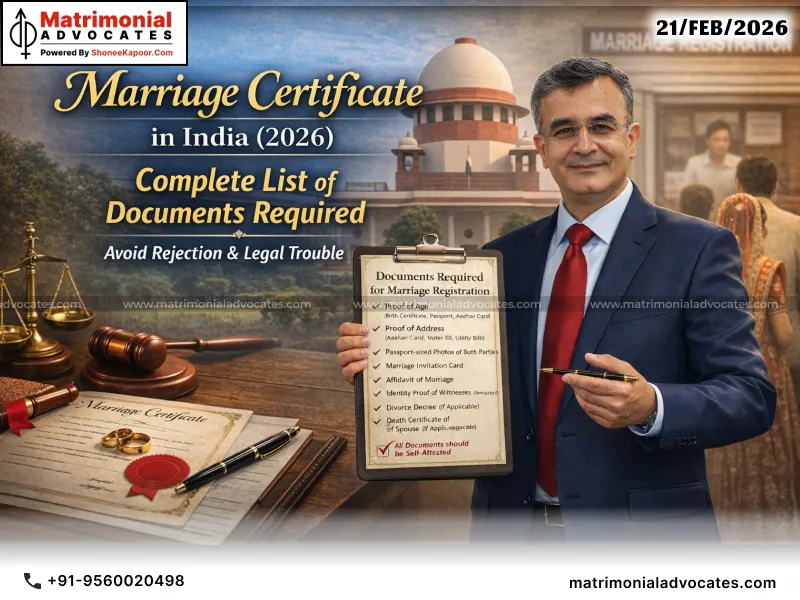
Core Documents Required
Applicants must provide standard documents verifying identity, age, address, and proof of marriage. Despite minor state-level variations, the following constitutes the essential documentation for registration.
Identity Proof (any one each)
- Aadhaar card
- Passport
- PAN card
- Voter ID
- Driving licence
Address Proof (any one each)
- Aadhaar card / Passport
- Utility bill (electricity, water, gas)
- Rent agreement
- Bank passbook with address
Age Proof (any one each)
- Birth certificate
- School leaving certificate
- Passport
- Secondary school certificate
Marriage Proof
- Wedding photographs
- Marriage invitation card
- Certificate from priest or marriage solemnization authority (where applicable)
Witness Documents
- 2–3 witnesses with identity and address proof
- Passport-size photographs of witnesses
Additional Documents (Case-Specific)
Certain circumstances require supplementary documentation:
- Certified copy of divorce decree (if previously married)
- Death certificate of deceased spouse (widow/widower)
- Conversion certificate (if religion changed prior to marriage)
- Gazette notification for name change
- Affidavits declaring marital status and nationality
Differences in Documentation: Hindu Marriage Act vs Special Marriage Act
Hindu Marriage Act Registration
- Applicable when marriage already solemnized through religious ceremony
- Priest certificate often required
- No statutory notice period
- Registration acts as post-solemnization legal recording
Special Marriage Act Registration
- Applicable to civil and interfaith marriages
- Mandatory 30-day notice period
- Publication of notice at registrar office
- Additional affidavits and residence proof required
Step-by-Step Marriage Registration Process
- Filing application with jurisdictional marriage registrar
- Submission and verification of documents
- Scheduling of appointment or notice period compliance (civil marriage)
- Physical presence of parties and witnesses before registrar
- Signing of marriage register
- Issuance of marriage certificate (same day or within prescribed timeline)
State-wise Variations to Note
While documentation remains largely uniform, administrative differences may exist:
- Availability of online application portals
- Variation in number of witnesses required
- State-specific affidavit formats
- Jurisdiction rules based on residence duration
Common Mistakes Leading to Rejection
Applications may be rejected due to procedural lapses or document inconsistencies, making error awareness essential for smooth processing.
- Address mismatch across documents
- Missing witness identification
- Incomplete affidavits or incorrect declarations
- Failure to comply with notice period under civil marriage
- Absence of jurisdictional proof
Practical Tips for Faster Approval
Proper preparation and document accuracy can significantly expedite verification and certificate issuance.
- Maintain notarized affidavits beforehand
- Carry originals along with photocopies
- Ensure witnesses are available on scheduled date
- Verify registrar jurisdiction prior to filing
- Cross-check spelling consistency across all documents
CONCLUSION
Marriage registration serves as a legally reliable record of the marital relationship, strengthening recognition of rights and obligations under law.
Careful documentation, procedural accuracy, and awareness of statutory distinctions significantly reduce the risk of objections or delays.
A structured and well-prepared approach enables couples to obtain their marriage certificate efficiently while ensuring long-term legal clarity and protection.
For structured legal assistance and error-free marriage registration without procedural delays, contact our office today at +91-9560020498.
FAQs
- Is marriage registration mandatory in India?
Marriage registration is not uniformly mandatory across India; however, courts strongly recommend it as primary legal proof of marriage for administrative and dispute-related purposes.
- Can a marriage certificate be obtained without witnesses?
No. Presence and identification of witnesses is a mandatory statutory requirement during registration. - Does documentation differ between religious and civil marriages?
Yes. Civil marriages under the Special Marriage Act involve a notice period and additional affidavits compared to post-solemnization registration under personal laws. - . Can a marriage certificate be issued if one party does not appear before the registrar?
No. Physical presence of both parties before the Marriage Registrar is mandatory at the time of registration.
- Can marriage registration protect parties in matrimonial disputes?
A marriage certificate serves as strong evidentiary proof of marital status, helping prevent denial of marriage and supporting enforcement of legal rights.