
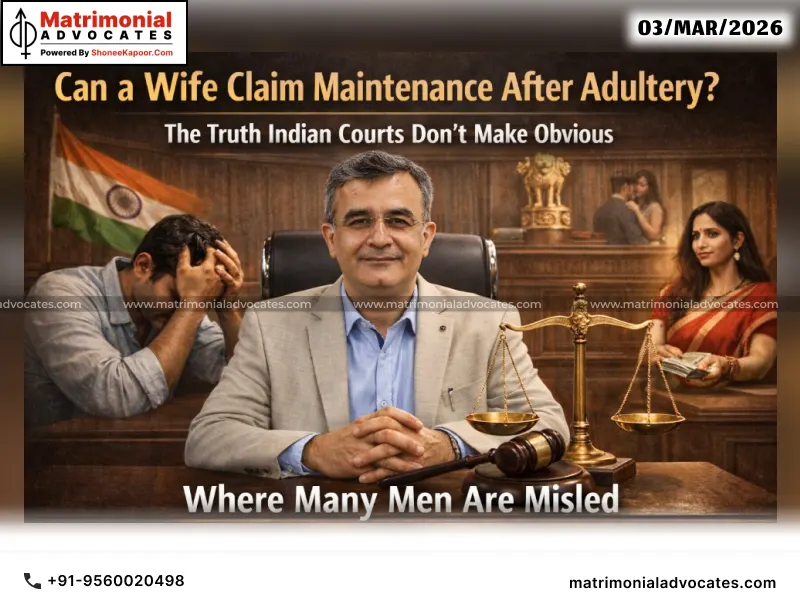
Many husbands assume infidelity ends financial liability. The law says otherwise and the difference between morality and statutory wording is where most men lose their cases.
NEW DELHI: When adultery enters a marriage dispute, one question dominates every consultation:
“If she has been unfaithful, can she still demand maintenance?”
The assumption among many husbands is simple — infidelity cancels financial rights.
Indian law, however, does not operate on moral outrage. It operates on statutory wording.
And that difference changes everything.
Maintenance law in India is frequently misunderstood, particularly when allegations of adultery are involved. Many husbands assume that once infidelity is established, the wife automatically loses the right to claim financial support.
The reality, however, is more complex and depends entirely on the statutory framework governing the maintenance sought.
Indian law does not treat maintenance as a moral reward or punishment. It is primarily a socio-economic safeguard designed to prevent destitution. Whether adultery affects entitlement depends on the wording of the specific statute and the manner in which courts have interpreted it.
At this stage, the question inevitably arises:
“If she has been unfaithful, how can she still claim maintenance?”
The answer lies not in emotion, but in statutory interpretation.
Let us examine the position law by law.
Maintenance Under Section 125 CrPC
Statutory Position
Section 125(4) of the Code of Criminal Procedure clearly states:
A wife shall not be entitled to maintenance if she is living in adultery.
This is the only maintenance provision in India that expressly creates a statutory bar.
What Does “Living in Adultery” Mean?
Courts have repeatedly clarified that:
- A single act of adultery is not enough.
- It must show a continuous course of adulterous conduct.
- The burden of proof lies on the husband.
Key Judicial Interpretations
In Rohtash Singh v. Ramendri (2000) 3 SCC 180, the Supreme Court clarified that even a divorced wife can claim maintenance unless she is disqualified under Section 125(4), including “living in adultery.”
However, courts have consistently required strict proof. Mere suspicion, photographs, or WhatsApp chats are usually insufficient unless they establish sustained adulterous cohabitation.
High Courts have repeatedly held that:
- “Living in adultery” implies a quasi-permanent arrangement.
- Casual or stray allegations do not meet the threshold.
Practical Reality
This provision exists, but in practice:
- Proof is difficult.
- Evidence must be cogent and legally admissible.
- The husband must show continuity, not just misconduct.
Maintenance Under the Hindu Marriage Act, 1955
Now the legal terrain changes.
Section 24 – Interim Maintenance
This provision focuses on:
- Financial incapacity.
- Income disparity.
Adultery is not an automatic bar here.
In Rajnesh v. Neha (2020) 14 SCC 150, the Supreme Court laid down structured guidelines for maintenance determination. The focus was financial disclosure and economic fairness — not moral adjudication.
Section 25 – Permanent Alimony
Here, conduct of the parties can be considered.
But consider this carefully:
- Adultery may influence quantum.
- It does not automatically extinguish entitlement.
Courts weigh:
- Duration of marriage
- Financial position
- Conduct of both parties
- Earning capacity
Maintenance under HMA is discretionary and equitable — not punitive.
Maintenance Under the Protection of Women from Domestic Violence Act, 2005
Under Section 20 PWDVA, monetary relief can be granted if:
- A domestic relationship is established.
- Economic abuse or need is shown.
There is no explicit statutory bar for adultery in the Act.
Courts focus on:
- Financial dependency
- Standard of living
- Comparative income
Even if adultery is alleged, unless it breaks the domestic relationship in a legally relevant manner, maintenance may still be granted.
Critical Distinction: Moral Wrong vs Legal Disqualification
Many husbands conflate moral wrongdoing with statutory disqualification.
Only Section 125 CrPC creates a direct statutory bar.
Other statutes leave the issue to judicial discretion.
Courts repeatedly emphasise:
- Maintenance is a social welfare remedy.
- It is not meant to punish immoral conduct.
- It is meant to prevent destitution.
Burden of Proof
If adultery is alleged:
- The husband must prove it.
- Standard is higher than mere probability.
- Circumstantial evidence must form a consistent chain.
Mere allegations can backfire if unsubstantiated.
Strategic Considerations for Husbands
If faced with such a claim:
- Identify which statute is invoked.
- Examine whether Section 125(4) CrPC applies.
- Gather admissible, legally sustainable evidence.
- Challenge financial disclosure inconsistencies.
- Focus on earning capacity and concealment.
An adultery allegation without evidence weakens credibility.
CONCLUSION
Can a wife claim maintenance after adultery?
Under Section 125 CrPC — not if she is “living in adultery” and it is strictly proved.
Under the Hindu Marriage Act — possibly yes, subject to judicial discretion.
Under the Domestic Violence Act — very likely yes, unless other disqualifications exist.
The law does not automatically reward or punish morality. It evaluates financial dependency, statutory wording, and evidence.
Emotionally, it feels unjust to many husbands. Legally, the answer is statute-specific and evidence-driven.
That distinction is where most cases are won or lost.
FAQs
- Does adultery automatically cancel a wife’s right to maintenance?
No. Only Section 125(4) CrPC creates a statutory bar, and that too only if she is proven to be “living in adultery.” Under other laws, adultery is not an automatic disqualification. - What does “living in adultery” legally mean?
It requires proof of a continuous adulterous relationship, not a single alleged incident. The burden of proof lies entirely on the husband. - Can a wife get maintenance under the Hindu Marriage Act despite adultery?
Yes. Under Sections 24 and 25 HMA, courts focus on financial dependency and may only consider conduct while deciding the amount, not automatic rejection. - Does adultery block maintenance under the Domestic Violence Act?
No. The PWDVA does not contain any explicit bar based on adultery. Courts primarily assess economic need and domestic relationship. - What should a husband do if adultery is involved?
He must rely on legally admissible evidence, identify the correct statutory provision, and challenge financial dependency rather than assume that moral misconduct alone will defeat the claim.