

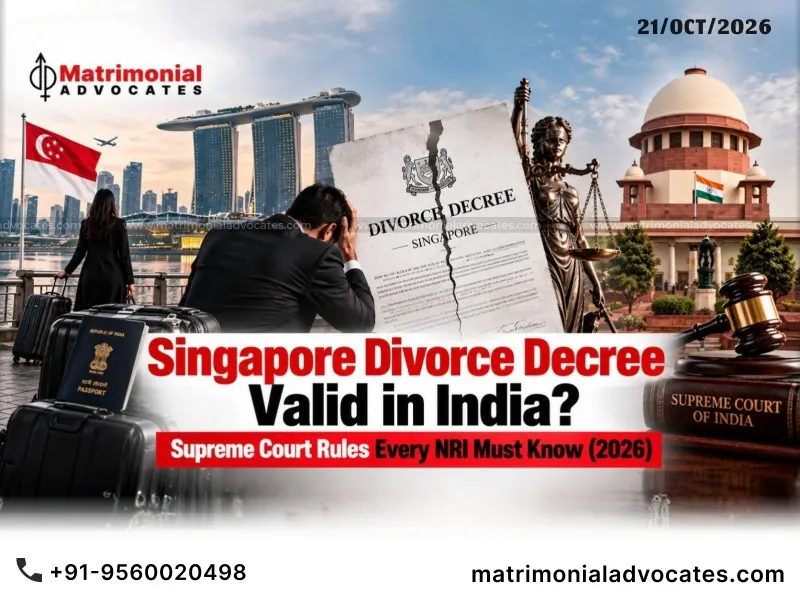
A Singapore court may grant divorce, but Indian law can still treat the couple as married. Here is when a foreign divorce is recognised, rejected or challenged in India.
NEW DELHI: Imagine obtaining a divorce decree in Singapore, moving on with life, and discovering that your marriage may still legally subsist in India.
This is a genuine legal risk for NRIs. A foreign divorce decree is not automatically binding in India merely because it was granted by a competent Singapore court.
The decisive questions are whether the foreign court’s jurisdiction, the grounds of divorce and the proceedings satisfy Indian law.
IS A SINGAPORE DIVORCE DECREE VALID IN INDIA?
Yes, a Singapore divorce decree can be recognised in India, but it must satisfy Section 13 of the Code of Civil Procedure, 1908 (CPC), and the applicable matrimonial law.
For marriages governed by the Hindu Marriage Act, 1955 (HMA), the relevant provisions include:
- Section 13 HMA: Recognised grounds for contested divorce.
- Section 13B HMA: Divorce by mutual consent.
- Section 19 HMA: Jurisdiction of Indian matrimonial courts.
- Section 13 CPC: When foreign judgments are not conclusive.
- Section 14 CPC: Rebuttable presumption of foreign courts’ jurisdiction.
Singapore’s divorce law recognises irretrievable breakdown of marriage, including breakdown established by mutual agreement. However, irretrievable breakdown is not an ordinary statutory Fground for divorce under Section 13 HMA.
Therefore, a decree valid under Singapore law may still face a recognition challenge in India.
WHEN WILL INDIAN COURTS RECOGNISE OR REJECT A SINGAPORE DIVORCE?
| SINGAPORE DIVORCE SITUATION | POSITION UNDER INDIAN LAW |
| Both spouses genuinely consented to the divorce | Generally capable of recognition, subject to legal requirements |
| Respondent voluntarily contested divorce on a ground recognised under the applicable Indian matrimonial law | May be recognised |
| Divorce granted ex parte without effective participation | Vulnerable to challenge |
| Contested divorce based solely on irretrievable breakdown under HMA-governed marriage | May be refused recognition |
| Divorce obtained by fraudulent claims about jurisdiction or residence | Vulnerable to rejection under Section 13 CPC |
Mere service of a foreign court notice does not necessarily establish voluntary submission to that court’s jurisdiction.
SUPREME COURT: FOREIGN DIVORCE CANNOT OVERRIDE INDIAN MATRIMONIAL LAW
- Y. Narasimha Rao v. Y. Venkata Lakshmi — (1991) 3 SCC 451
The Supreme Court established the controlling principles for recognising foreign matrimonial judgments.
The Court explained that the foreign court’s jurisdiction and the grounds of divorce must conform to the matrimonial law governing the marriage, subject to recognised exceptions involving residence, effective submission or genuine consent.
Key principle: A spouse cannot simply choose a foreign jurisdiction to bypass the legal protections available under Indian matrimonial law.
- Kishorekumar Mohan Kale v. Kashmira Kale — 2026 SCC OnLine SC 448
Supreme Court | 15 January 2026 | Justices Vikram Nath and Sandeep Mehta
In this case, the wife secured a divorce in the United States on the ground of marital breakdown.
The husband had challenged the foreign court’s jurisdiction and had not effectively submitted to its proceedings.
The Supreme Court held that the foreign divorce was not conclusive under Indian law because the relevant recognition requirements were unmet.
However, considering approximately 18 years of separation, the Supreme Court independently dissolved the marriage using Article 142 of the Constitution.
The distinction is crucial: an invalid foreign decree does not become valid merely because the Supreme Court subsequently grants divorce through its extraordinary constitutional powers.
2026 DELHI HIGH COURT: IS A FRESH INDIAN DECLARATION ALWAYS NECESSARY?
Pritam Dey v. Union of India & Ors. — 2026:DHC:4932
Delhi High Court | 29 May 2026 | Justice Purushaindra Kumar Kaurav
An Indian husband obtained a mutual-consent divorce in Canada and subsequently remarried.
Passport authorities refused to update his marital records without a separate Indian court declaration.
What happened in court?
The authorities argued that the Passport Manual required an Indian declaratory decree and that execution under Section 44A CPC was necessary.
The High Court rejected the Section 44A argument as “fundamentally misconceived”.
Finding that both spouses had voluntarily participated and that the decree satisfied Section 13 CPC, the Court held that a separate Indian declaration could not be insisted upon in those circumstances.
The authorities were directed to process the passport request without that requirement.
This ruling is relevant to qualifying Singapore mutual-consent decrees, although the underlying case concerned Canada.
Read the official Delhi High Court judgment
CAN A HUSBAND STOP DIVORCE PROCEEDINGS FILED IN SINGAPORE?
Not automatically.
In Mihir Prakash Bajoria v. Vidushi Jain Bajoria, 2026 INSC 1034 (22 September 2026), the Supreme Court held that anticipated non-recognition of a future foreign divorce decree was not, by itself, sufficient to justify restraining foreign matrimonial proceedings.
The case concerned proceedings in the United Kingdom, not Singapore. The Supreme Court did not decide the validity of any final foreign divorce decree.
The practical distinction: challenging the recognition of a completed foreign divorce and obtaining an injunction against ongoing foreign litigation are two different legal questions.
IS APOSTILLE ENOUGH TO MAKE SINGAPORE DIVORCE VALID IN INDIA?
No. Apostille authenticates the document; it does not establish the legal validity of the divorce.
Singapore’s apostille system permits appropriate public documents to be authenticated for use in India without additional consular legalisation.
Couples should obtain the Final Judgment, not merely Singapore’s Interim Judgment.
Passport-related requirements can involve additional complications. The Ministry of External Affairs’ May 2026 instructions continued to refer to an Indian declaratory order for marriages solemnised in India or under Indian laws. However, the Delhi High Court in Pritam Dey and the Kerala High Court in Fathima Majida M. v. Union of India (9 July 2026) rejected such blanket insistence in the circumstances before them.
WHAT SHOULD AN NRI HUSBAND DO BEFORE ACCEPTING A SINGAPORE DIVORCE?
Check the foreign court’s jurisdiction, the divorce ground, actual consent, service of proceedings and whether the judgment is final.
Preserve the court filings, jurisdictional objections, consent documents and final order.
Do not assume a contested Singapore decree has ended your marriage for Indian legal purposes. Equally, do not assume every foreign divorce requires a second divorce proceeding in India.
Recognition must be assessed against the actual decree and governing Indian law, particularly before remarriage.
FINAL WORD: DIVORCED IN SINGAPORE DOES NOT ALWAYS MEAN DIVORCED IN INDIA
A foreign divorce must meet Indian recognition standards; neither spouse can simply presume that an overseas decree overrides the matrimonial law applicable in India.
A Singapore divorce certificate is evidence of a foreign court’s decision. Whether that decision is binding in India is a separate legal question.
For NRIs, checking the legal validity of a foreign divorce before remarriage or further litigation is essential.
FAQ’S
- Is a Singapore divorce decree automatically valid in India?
No. It must satisfy Section 13 CPC and the applicable Indian matrimonial law.
- Is mutual-consent divorce from Singapore recognised in India?
It can be. Genuine consent, competent jurisdiction and compliance with recognition requirements are critical.
- Can an Indian husband challenge an ex parte Singapore divorce?
Yes. Lack of jurisdiction, denial of natural justice and other Section 13 CPC exceptions may justify a challenge.
- Is irretrievable breakdown a valid divorce ground under HMA?
Not ordinarily. It is not a statutory Section 13 HMA ground; the Supreme Court may invoke Article 142 in appropriate cases.
- Must every Singapore divorce be approved again by an Indian court?
No blanket rule applies. Recognition may arise under Section 13 CPC, although administrative disputes can necessitate legal proceedings.
Legal disclaimer: This article provides general legal information. Recognition depends on the law governing the marriage, the foreign decree, jurisdiction, procedure and case-specific evidence.
You May Also Like:
 Hindu Marriage Act 1955
 Divorce in India vs Divorce Abroad: Which One Is Valid? The Complete Legal Guide for NRIs
 NRI Divorce in UAE: What Indian Law Says About Validity, Recognition, and Your Real Legal Status
 What Is Exceptional Hardship For Divorce Within 1 Year Of Marriage? Complete Legal Guide 2026