
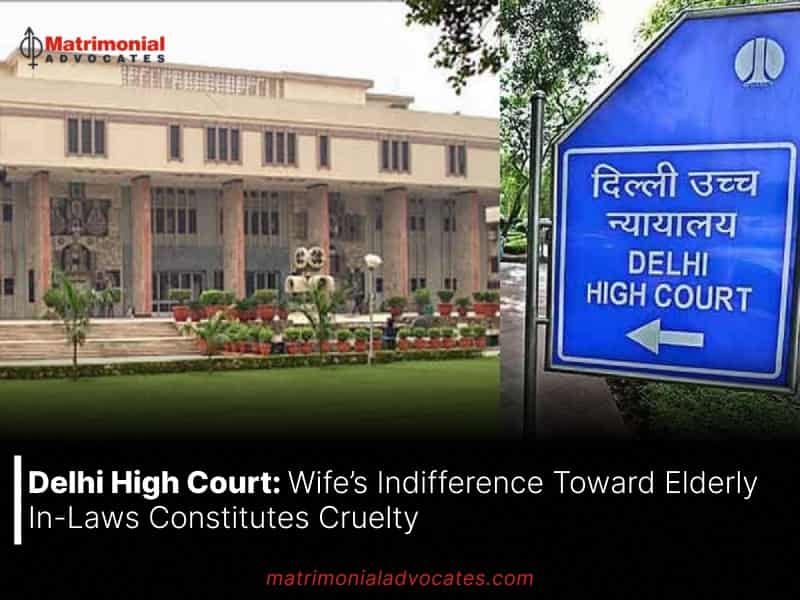
A spouse is expected to care for aged parents and elders in the household, the Court observed.
The Delhi High Court has recently ruled that a wife’s indifference toward her elderly in-laws amounts to cruelty under matrimonial law, providing the husband valid grounds for divorce.
A Division Bench of Justices Anil Kshetarpal and Harish Vaidyanathan Shankar observed that parents are an integral part of a joint Hindu family, and a spouse’s neglect or apathy toward them adds an element of cruelty in matrimonial matters.
The Court further underscored that a spouse is expected to extend care and compassion toward elderly parents and senior family members residing in the household.
While deciding the matrimonial dispute, the Court noted that the wife—who had challenged the divorce decree—was unaware that her mother-in-law was bedridden and had undergone hip replacement surgery.
The Court observed that this level of indifference reflected the wife’s disregard for the basic marital responsibilities expected within the Indian family system.
“It is a natural and legitimate expectation that a spouse, upon entering matrimony, would demonstrate care and concern for the health and dignity of the elders in the household. The studied apathy and want of sensitivity displayed by the Appellant [wife] towards her in-laws, particularly when their advanced age and health conditions required compassion, cannot be treated as trivial. This conduct inflicted avoidable anguish on the Respondent [husband] and his family, thereby amounting to another facet of cruelty within the scope of matrimonial law,” the Court observed.
The High Court made these observations while rejecting the wife’s appeal against the family court’s order that granted the husband a divorce on the grounds of cruelty.
The couple, who married in March 1990, had a son in 1997. The husband alleged that his wife was reluctant to live in a joint family, frequently left the matrimonial home without his consent, and had withdrawn from marital relations since 2008. He further contended that she had pressured him and his family to transfer property in her name and, after he filed for divorce in 2009, initiated multiple criminal cases against them.
The family court granted the husband a divorce, holding that the wife’s persistent refusal to resume cohabitation and her retaliatory FIRs amounted to mental cruelty.
In her appeal, the wife argued that the trial court had considered evidence beyond the pleadings and had ignored her allegations of dowry harassment and ill-treatment. She further asserted that her criminal complaints were genuine and not driven by malice or retaliation.
The High Court, however, rejected her arguments, ruling that the prolonged denial of marital intimacy and persistent acts of harassment constituted mental cruelty within the meaning of the Hindu Marriage Act, 1955.
“The prolonged denial of marital intimacy, the series of complaints instituted against the Respondent, the deliberate alienation of the minor child, and the indifference towards the Respondent’s parents collectively demonstrate a sustained neglect of marital responsibilities. These actions have caused the Respondent and his family considerable emotional suffering, thereby constituting cruelty of such gravity as to justify dissolution of the marriage under Section 13(1)(ia) of the HMA,” the Court ruled.