
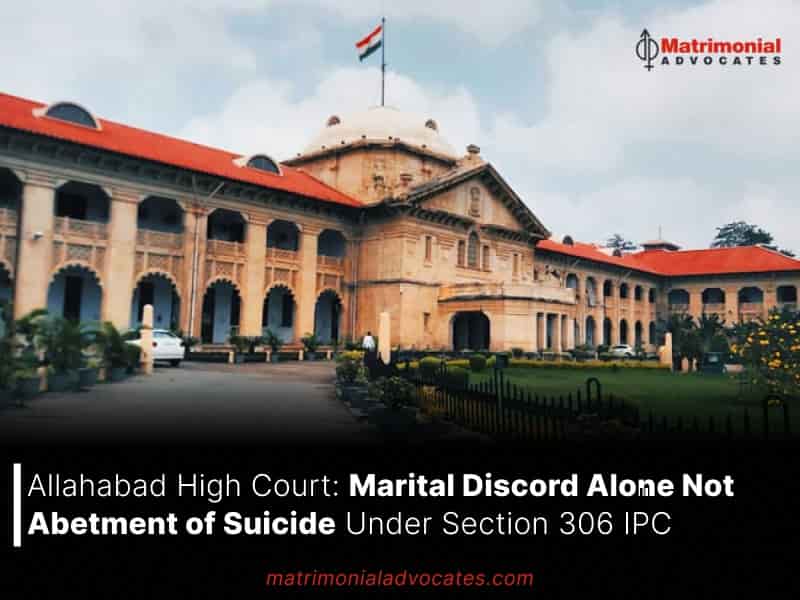
The Allahabad High Court recently observed that disagreements and conflicts in married life are common, and the suicide of a spouse over such issues cannot automatically be deemed abetment of suicide.
Justice Sameer Jain made this remark while setting aside a Sessions Court order that had rejected a discharge plea filed by a woman and her parents, who were facing trial under Section 306 IPC for allegedly abetting the suicide of her husband.
The judge clarified that merely saying statements like “he should die” during a marital quarrel, followed by the spouse taking their own life, does not constitute an offence under Section 306 IPC, as such words alone cannot amount to abetment.
Background
In November 2022, an FIR was lodged claiming that the deceased husband, who had married Revisionist No. 1 around seven years earlier, took his own life due to ongoing harassment and humiliation by his wife and her parents.
The complaint alleged that the wife had previously filed criminal cases under Sections 498-A, 323, 504, 506 IPC, and Sections 3/4 of the Dowry Prohibition Act. Although a settlement had been reached, she reportedly did not withdraw the cases.
The FIR also stated that on November 8, 2022, Revisionists No. 2 and 3 (the deceased’s in-laws) visited the couple’s home and, during an argument, allegedly said, “he should die.” A few days later, on November 13, 2022, the deceased (O.P. No. 2) was found dead, having committed suicide.
After the investigation, a charge sheet was filed against the wife and her parents, and the Sessions Court took cognizance of the case. When the trial court rejected their discharge plea on October 19, 2023, they moved the High Court through the current revision petition.
Submissions
The counsel for the revisionists argued that the abetment charges were unfounded, emphasizing that disputes between husband and wife are a normal aspect of marital life.
They maintained that there was no evidence of deliberate provocation, and even the statement allegedly made on November 8, 2022, could not amount to abetment.
On the other hand, the State and the complainant’s counsel opposed the revision, contending that multiple statements and pieces of evidence pointed to harassment, insult, and instigation, including the in-laws’ remark, which prima facie indicated an offence under Section 306 IPC.
High Court’s order
The Court noted at the outset that if the material on record, prima facie, does not establish the alleged offence, the accused should be discharged.
The bench also highlighted Section 306 IPC, stressing that instigation is a key element of the offence, involving the act of provoking, inciting, or encouraging someone to commit an act.
Justice Jain further observed:
“Mens rea to abet the commission of suicide is essential for offence punishable under Section 306 IPC. If husband or wife or their relatives are being either harassed or tortured but without any intention to commit suicide, then it cannot be said that there was abetment…even if entire material collected by I.O. during investigation are accepted as it is then also it could not be reflected that revisionists were having mens rea to abet the deceased for suicide”.
The Court stressed that even if witnesses stated the in-laws told the deceased “he should die” during an argument, such words, spoken in the heat of the moment, did not constitute instigation. The evidence did not show that the deceased was compelled to commit suicide.
In view of this, the Court concluded that no prima facie offence under Section 306 IPC was made out against the revisionists. Accordingly, their revision petition was allowed, and the trial court’s order rejecting their discharge plea was overturned.