

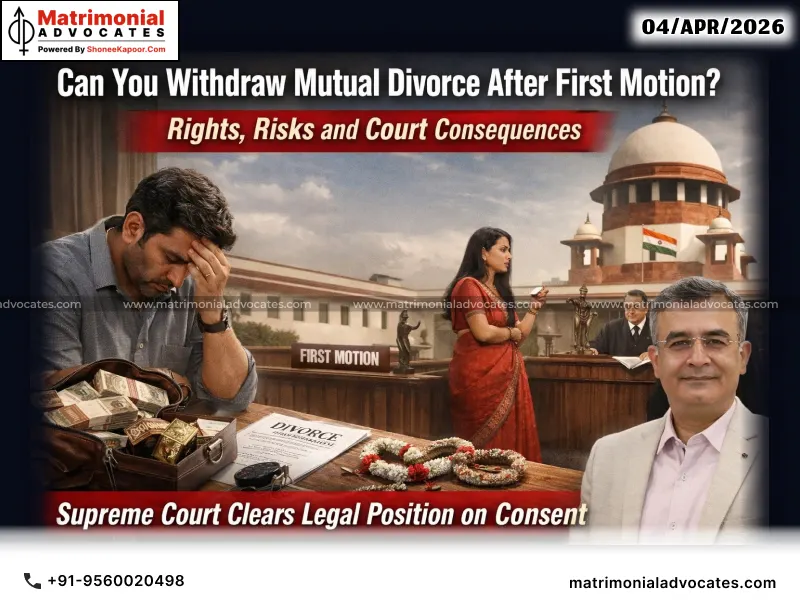
Can mutual divorce be withdrawn after first motion in India? Section 13B HMA, Section 28 SMA, Supreme Court rulings, legal consequences, settlement risks, and what husbands must do next.
NEW DELHI: In India, a mutual divorce does not become final merely because the first motion has been filed or statements have been recorded. That is where many spouses, especially husbands under settlement pressure, make a costly mistake.
The law is clear: till the final decree is actually passed, consent must remain alive, free, and mutual. If either spouse withdraws consent before the decree, the court ordinarily cannot grant divorce by mutual consent. That is not opinion. That is the settled statutory position under Section 13B of the Hindu Marriage Act, 1955, and the Supreme Court’s interpretation of it.
We at Matrimonial Advocates positions ourselves as a litigation-focused matrimonial law firm with pan-India mutual divorce work, strategic clarity, and process guidance on timelines, documentation, and court handling. We believe mutual divorce as a fast-track route when properly structured.
But the biggest disaster in mutual divorce practice is not filing the first motion. It is assuming that first motion means the marriage is practically over. It does not.
THE STATUTE FIRST: WHAT THE LAW ACTUALLY SAYS
Under Section 13B of the Hindu Marriage Act, spouses can jointly seek divorce by mutual consent if they have been living separately for at least one year, have not been able to live together, and have mutually agreed that the marriage should be dissolved.
The statute then requires a second stage: a joint motion by both parties after the prescribed interval, followed by the court’s satisfaction that the consent is genuine and the averments are true.
The Special Marriage Act, 1954 follows the same two-stage structure under Section 28.
That means the first motion is not the divorce. It is only the opening procedural stage. The final dissolution happens only when the second motion is moved by both parties and the court passes the decree.
THE DIRECT ANSWER: YES, CONSENT CAN BE WITHDRAWN AFTER FIRST MOTION
The Supreme Court in Sureshta Devi v. Om Prakash held that mutual consent must exist not only at the time of filing but also when the court is asked to pass the decree. In Hitesh Bhatnagar v. Deepa Bhatnagar, the Court reiterated that either party may withdraw consent at any time before the decree is passed, and that in the absence of the second motion by both sides, no court can grant a decree of mutual divorce.
A later Constitution Bench judgment of the Supreme Court also reaffirmed that this is the governing position and noted that the ratio in Sureshta Devi was approved by a three-judge bench in Smruti Pahariya v. Sanjay Pahariya.
The most important legal point is this: mutual consent is not a one-time signature; it is a continuing jurisdictional requirement. Once that consent disappears, the court’s power to grant a mutual consent decree disappears with it.
WHAT THE SUPREME COURT SAID IN SUBSTANCE
The courts have repeatedly made the same point in slightly different language. In Sureshta Devi, as reproduced in later Supreme Court rulings, the Court held in substance that if there is no mutual consent at the time of inquiry, the court gets no jurisdiction to pass a divorce decree. In Hitesh Bhatnagar, the Court again made it clear that one party may withdraw consent before the decree and that “complete agreement” remains essential.
This is the legal reality many parties ignore while signing settlement memorandums, exchanging money, withdrawing complaints, or planning remarriage too early. First motion is not victory. It is only a step.
DOES THE SIX-MONTH COOLING-OFF WAIVER CHANGE THIS? NO.
Another common confusion is between waiver of the cooling-off period and withdrawal of consent. They are not the same thing. In Amardeep Singh v. Harveen Kaur, later explained by the Supreme Court in Amit Kumar v. Suman Beniwal, the Court held that the six-month waiting period under Section 13B(2) is directory, not mandatory, and can be waived in appropriate cases where reconciliation is not possible and the waiting period would only prolong agony.
But even where the waiting period is waived, the requirement of continuing consent does not vanish.
So the law today is simple: the cooling-off period may be waived by the court in a fit case, but the need for both spouses to continue consenting till decree remains intact. Waiver of time is not waiver of consent.
WHAT HAPPENS IF ONE SPOUSE WITHDRAWS AFTER FIRST MOTION?
The first and immediate consequence is that the mutual divorce petition usually collapses. Without the second motion by both parties, the Family Court cannot ordinarily pass a decree of mutual consent divorce. Even if the petition remains on file, non-withdrawal of the petition itself is not enough. The statutory requirement is not merely a pending petition; it is a continuing joint request backed by subsisting consent.
The second consequence is strategic, not symbolic. If a husband has already paid a large first tranche of settlement money, returned stridhan, withdrawn other proceedings, or made concessions in anticipation of second motion, he may suddenly find himself trapped in an expensive halfway arrangement: no marriage, no closure, no decree, and sometimes no practical recovery without fresh litigation.
That is precisely why settlement drafting and staged compliance matter. The law allows withdrawal of consent; it does not guarantee immunity from the downstream legal fallout of breaking the broader settlement.
CAN A COURT FORCE THE OTHER SIDE TO GIVE SECOND MOTION CONSENT? NO.
This is where many litigants receive bad advice. The Delhi High Court in Rajat Gupta v. Rupali Gupta held that Section 13B recognizes an “unqualified and unfettered right” to withdraw consent before the final decree. The Court expressly said the defaulting party cannot be compelled to file or appear for the second motion so as to obtain divorce by mutual consent.
It also held that any contrary approach would cut into a statutory right preserved by Section 13B itself.
So if someone asks,
“Can I get an order forcing my spouse to come and say yes at second motion?”
the answer under ordinary matrimonial procedure is no. A mutual divorce cannot be converted into a coercive divorce.
THEN IS THERE NO CONSEQUENCE FOR WITHDRAWING CONSENT? NOT EXACTLY.
This is where the law gets more nuanced. Rajat Gupta does not mean that a party can breach a settlement with zero consequences. What it says is that the court cannot compel consent for the divorce itself.
At the same time, the Delhi High Court also held that where undertakings or settlement terms have been breached, the aggrieved party may seek relief such as restoration of status quo ante, disgorgement of benefits, or contempt consequences in an appropriate case, depending on the nature of the undertaking and the prejudice caused.
In plain terms: no one can be forced to give mutual divorce consent, but someone who took money, got cases quashed, secured benefits, or induced withdrawals on the strength of a settlement may still face legal consequences for breaching the non-divorce parts of that arrangement.
THE PRACTICAL CONSEQUENCES HUSBANDS NEED TO UNDERSTAND
If you are the husband and the wife withdraws consent after first motion, the consequences usually fall into five categories.
- First, the mutual divorce itself fails unless consent revives and both sides proceed again.
- Second, payments already made under settlement may become disputed. Recovery is not automatic, but restoration, execution, or fresh proceedings may become necessary depending on the wording of the settlement and court orders.
- Third, any criminal or civil cases kept in abeyance as part of settlement strategy may revive, continue, or need to be re-litigated if the settlement collapses. That is why blind front-loaded concessions are reckless.
- Fourth, the husband may have to shift from mutual divorce strategy to contested divorce strategy on grounds such as cruelty, depending on the facts. False settlement inducement, strategic withdrawal after extracting benefits, or litigation abuse may become evidentiary material in later proceedings, though each case turns on facts.
- Fifth, remarriage plans, immigration filings, property transfers, and tax structuring built around an “assumed divorce” may all collapse because legally there is still no decree. Until the decree is passed, the marriage subsists.
WHAT IF THE SECOND MOTION IS NEVER FILED WITHIN 18 MONTHS?
Section 13B contemplates the second motion within the statutory window.
In Hitesh Bhatnagar, the Supreme Court made clear that if the second motion is not made by both parties within that period, the court is not bound to grant divorce by mutual consent, and mere non-withdrawal before expiry of 18 months does not cure the defect.
In other words, silence is not consent, and a dead petition does not ripen into a decree.
CAN HIGH COURTS OR FAMILY COURTS DISSOLVE THE MARRIAGE ANYWAY BECAUSE IT HAS BROKEN DOWN? USUALLY NO.
Another dangerous myth is that once the marriage is obviously over, any court can somehow “convert” the matter into divorce. That is wrong. The Supreme Court has repeatedly drawn a distinction between ordinary statutory power and the extraordinary constitutional power under Article 142.
In Manish Goel, the Court stated that waiver contrary to statute could not be ordered by courts other than the Supreme Court under Article 142. In Hitesh Bhatnagar, the Supreme Court noted Anil Kumar Jain but declined to exercise Article 142 on those facts. A 2023 Constitution Bench decision also discussed the Supreme Court’s exceptional power to dissolve marriages in appropriate cases.
So the practical rule is this: a Family Court cannot bypass the statutory requirement of continuing mutual consent merely because the marriage is emotionally over. The ordinary court must follow Section 13B as written.
THE HARD TRUTH: MUTUAL DIVORCE IS FAST ONLY WHEN THE SETTLEMENT IS SMARTER THAN THE EMOTION
This is where legal strategy matters more than sentiment. Mutual divorce is often sold as easy, civilized, and quick. Sometimes it is. But when the first motion is filed without airtight staging of payment, case withdrawal, property transfer, quashing steps, child access arrangements, and default consequences, it can become a trap.
A badly drafted mutual settlement can hand one side all the leverage before the decree and leave the other side carrying the litigation burden after the withdrawal.
That is why the safer legal design in sensitive cases is usually phased compliance: obligations linked to procedural milestones, documentary proof, and decree-stage completion. The law gives both parties a right to rethink. Good drafting prevents that statutory right from turning into a litigation ambush.
FINAL LEGAL POSITION
Yes, a spouse can withdraw consent for mutual divorce after the first motion and before the final decree. If that happens, the court ordinarily cannot grant divorce by mutual consent. The cooling-off period may be waived in a proper case, but continuing consent cannot be dispensed with in the ordinary statutory process.
No court can force a spouse to give second motion consent merely because a settlement was signed. But breach of the wider settlement may still trigger serious legal consequences, including restoration, execution, disgorgement, or contempt-related remedies depending on the terms and the prejudice caused.
For husbands, the message is blunt: do not confuse first motion with final relief. Until decree day, the file is alive, the risk is alive, and your legal strategy must remain alive.
FAQ’s
- Can mutual divorce be withdrawn after first motion in India?
Yes. Either spouse can withdraw consent before the final decree, and then the court ordinarily cannot grant mutual divorce. - Is first motion equal to divorce?
No. First motion only starts the process. Divorce happens only after second motion and final decree. - Can the court force my spouse to appear for second motion?
No. A court cannot compel mutual consent for divorce. - If consent is withdrawn, does the settlement automatically become useless?
Not always. The divorce may fail, but breach of settlement terms can still have legal consequences. - Can the six-month cooling period be waived?
Yes, in suitable cases. But waiver of time does not remove the need for continuing consent till decree.