
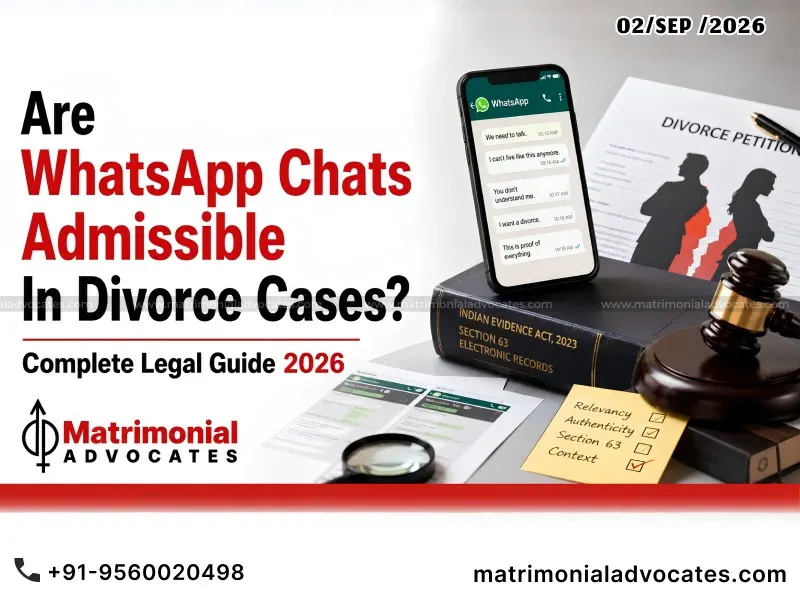
Can WhatsApp chats be used as evidence in an Indian divorce case? Understand Section 63 of the Bharatiya Sakshya Adhiniyam, Section 14 of the Family Courts Act, privacy objections, screenshots, certificates and the latest 2026 judgments.
NEW DELHI: A WhatsApp screenshot may find its way into a divorce case, but that alone does not mean it proves cruelty, adultery or any other ground for dissolving the marriage.
Modern matrimonial disputes often leave a digital trail long before the parties enter a courtroom. Threats, abusive messages, admissions, financial demands, allegations, apologies, discussions about separation and even conversations relied upon to allege an extramarital relationship may become relevant evidence.
But before relying on any WhatsApp conversation, four separate issues must be examined:
- Can the court take the chat on record?
- Is the conversation genuine and complete?
- Can it be proved who actually sent the messages?
- What evidentiary value will the court ultimately give it?
Many matrimonial cases become weak because these four questions are treated as if they mean the same thing.
Indian courts can receive WhatsApp chats as evidence in divorce proceedings when the conversations are relevant to the matrimonial dispute.
But producing a screenshot does not automatically establish that the conversation is genuine or that every message shown was actually sent by the alleged person.
WhatsApp evidence may still be challenged because of:
- incomplete or selectively cropped conversations;
- disputed phone numbers or account ownership;
- allegations of editing, manipulation or fabrication;
- missing dates, timestamps or surrounding messages;
- non-compliance with electronic-evidence certification requirements;
- failure to establish the actual sender of the message; or
- absence of any clear connection between the chat and the matrimonial allegation sought to be proved.
The distinction is critical:
Admitting a WhatsApp chat on record does not mean its contents are proved.
And even a proved conversation does not, by itself, automatically establish cruelty, adultery or another legal ground for divorce. The court must still examine the context, authenticity, surrounding evidence and whether the legal ingredients of the matrimonial ground have actually been proved.
WHICH EVIDENCE LAW APPLIES IN 2026?
This is where many outdated legal articles are now wrong.
The Bharatiya Sakshya Adhiniyam, 2023, came into force on 1 July 2024 and replaced the Indian Evidence Act, 1872.
Under the new law:
- Section 61 BSA recognises electronic and digital records and prevents their rejection merely because they are electronic.
- Section 62 BSA says the contents of electronic records may be proved according to Section 63.
- Section 63 BSA lays down the statutory framework for admissibility of specified electronic records and computer outputs.
But there is an important exception.
Section 170 of the BSA saves proceedings that were already pending immediately before 1 July 2024. Such proceedings continue to be dealt with under the old Indian Evidence Act.
Therefore:
A divorce proceeding governed by the new regime must be examined under the BSA and Section 63.
An older matrimonial proceeding saved by Section 170 may still require compliance with Section 65B of the Indian Evidence Act.
Do not mechanically file an old “65B certificate” in every new case without first identifying which evidence law governs the proceeding.
WHAT DOES SECTION 63 BSA MEAN FOR WHATSAPP EVIDENCE?
Where a WhatsApp conversation is produced as a computer output or copied electronic record falling within Section 63, the statutory conditions governing electronic evidence must be addressed.
Section 63(4) requires a certificate identifying the electronic record, explaining how it was produced, providing appropriate device particulars, and addressing the statutory conditions.
The BSA Schedule also contains the prescribed certificate framework.
In practical terms, if you intend to rely seriously upon WhatsApp evidence, do not preserve only a random screenshot.
Preserve:
- the original phone where possible;
- the complete relevant conversation;
- dates and timestamps;
- the phone number/account details;
- original media and attachments where relevant;
- exported chat records where appropriate;
- information identifying the source device; and
- the required electronic-evidence certificate in the applicable form.
A screenshot may be convenient.
A properly preserved digital record is evidence strategy.
FAMILY COURTS HAVE WIDER POWER UNDER SECTION 14
Another provision makes matrimonial cases different from ordinary civil litigation.
Section 14 of the Family Courts Act, 1984 permits a Family Court to receive reports, statements, documents, information or other material which, in its opinion, would assist it in dealing effectively with the dispute, even though that material may otherwise face ordinary evidentiary objections.
Section 20 gives the Family Courts Act overriding effect in case of inconsistency.
Courts have therefore repeatedly recognised that Family Courts possess wider flexibility while receiving material arising from the intensely private circumstances of marriage.
But Section 14 should not be misunderstood.
“The court can receive it” does not mean “the court must believe it.”
Authenticity, completeness, context and credibility remain crucial.
This distinction has become even more important after the recent 2025-2026 judgments.
SUPREME COURT ON PRIVACY BETWEEN SPOUSES: VIBHOR GARG V. NEHA
In Vibhor Garg v. Neha, 2025 INSC 829, the husband sought to produce secretly recorded telephonic conversations with his wife in matrimonial proceedings.
The Supreme Court restored the Family Court’s order permitting the material to be taken on record.
While the case concerned recorded conversations rather than WhatsApp chats specifically, its principle regarding spousal communications and privacy is extremely important for electronic evidence in matrimonial litigation.
The Supreme Court held that the marital-communication privilege under the old Section 122 itself contains an exception for litigation between spouses.
The Court stated:
“the right to privacy is not a relevant consideration”
in the particular context of the statutory exception applicable to suits between spouses.
The BSA now contains the corresponding rule in Section 128, which expressly retains an exception for suits between married persons.
Privacy therefore cannot be used as an automatic blanket to prevent every relevant matrimonial communication from reaching the court.
WHATSAPP CHATS OBTAINED WITHOUT CONSENT: ANJALI SHARMA CASE
In Anjali Sharma v. Raman Upadhyay, 2025 SCC OnLine MP 4217, the husband sought to rely upon WhatsApp conversations allegedly connected with his allegation of adultery.
The wife objected, citing privacy and alleged illegal procurement.
The Madhya Pradesh High Court upheld the Family Court’s decision permitting the chats to be exhibited under Section 14 of the Family Courts Act.
The Court observed that:
“The evidence is admissible so long as it is relevant”
but also made the equally important point that authenticity and genuineness must be scrutinised carefully.
The Court further clarified that receiving such evidence does not protect the person who obtained it from any separate civil or criminal consequences that may arise from an unlawful method of procurement.
That distinction matters.
Evidence law is not a licence to hack a spouse’s phone.
CHHATTISGARH HIGH COURT: WHATSAPP CHATS ALLOWED IN 2026
In Smt. Manjari Tiwari (Dubey) v. Vaibhav Dubey, WP227 No. 158 of 2025, 2026:CGHC:7712, decided on 11 February 2026, the husband sought to bring WhatsApp chats and mobile recordings on record in his divorce case.
The wife objected that the material had been obtained by hacking her phone and violated her privacy.
The Chhattisgarh High Court upheld the Family Court’s order allowing the electronic material to be brought on record. It relied upon Sections 14 and 20 of the Family Courts Act and the Supreme Court’s decision in Vibhor Garg.
Importantly, the husband’s counsel also submitted that a Section 65B certificate accompanied the electronic material in that proceeding.
The decision again demonstrates the critical distinction between permitting relevant electronic evidence to come on record and finally deciding whether that evidence is genuine and sufficient to prove the matrimonial allegation.
BOMBAY HIGH COURT’S 2026 WARNING: A WHATSAPP CHAT ALONE CANNOT WIN A DIVORCE
This is one of the most important judgments for anyone casually producing screenshots.
In Supriya Gaurav Devare v. Gaurav Jitendra Patil, 2026:BHC-AS:10374-DB, decided on 27 February 2026, the Family Court had granted an ex parte divorce while relying substantially upon WhatsApp and SMS chats.
The Bombay High Court set aside the decree and remanded the case.
Its warning was direct:
“Merely relying on the WhatsApp Chat, the divorce decree cannot be granted…”
The problem was not simply whether a screenshot existed. The evidence had to be proved, and the wife had to be given an opportunity to rebut it.
This case destroys a common misconception:
WhatsApp evidence may support a divorce case. WhatsApp screenshots do not automatically prove a divorce case.
PATNA HIGH COURT 2026: MISSING ELECTRONIC CERTIFICATE CAN DESTROY THE EVIDENCE
The latest warning is even sharper.
In Jyoti Rani v. Nishant Kumar, Miscellaneous Appeal No. 32 of 2024, decided on 6 August 2026, the husband relied on WhatsApp messages marked as Exhibit-1 to support his cruelty case.
Because the matrimonial proceeding was governed by the old Evidence Act, the Patna High Court examined compliance with Section 65B.
No Section 65B(4) certificate was produced.
Relying upon the Supreme Court’s Constitution Bench decision in Arjun Panditrao Khotkar v. Kailash Kushanrao Gorantyal, (2020) 7 SCC 1, the High Court held the WhatsApp messages inadmissible.
The Court stated:
“Oral evidence cannot supply the deficiency.”
The High Court ultimately set aside the divorce decree after finding the remaining evidence insufficient to establish the required cruelty.
This is precisely why electronic evidence should be prepared before trial, not repaired after the damage is done.
CAN THE COURT PRESUME WHO SENT A WHATSAPP MESSAGE?
Not automatically.
Section 90 BSA allows a limited presumption relating to transmission of an electronic message, but expressly says that the Court shall not presume the identity of the person who sent it.
Therefore, simply displaying a spouse’s name above a WhatsApp screenshot does not conclusively establish authorship.
Depending on the dispute, you may need to support authorship with the phone number, device, admissions, surrounding conversation, account details, witnesses, metadata, or other corroborative circumstances.
A saved contact name is not digital forensics.
SCREENSHOT OR FULL WHATSAPP CHAT: WHICH IS STRONGER?
A complete and properly preserved WhatsApp conversation generally carries greater evidentiary value than an isolated or cropped screenshot.
A screenshot may raise questions about missing context, deleted messages, editing, account ownership, authorship and whether the date of the conversation matches the incident pleaded in the divorce petition. These issues become especially important where chats are relied upon to prove threats, abusive conduct, financial pressure, defamatory allegations or other acts said to constitute matrimonial cruelty.
Instead of producing large numbers of disconnected screenshots, a better approach is to preserve the complete relevant conversation, arrange the chats chronologically, link each important message to the allegation it supports, and ensure the electronic record is properly authenticated.
In matrimonial litigation, organised and properly proved digital evidence is far more useful than a collection of screenshots without context.
CAN YOU HACK YOUR SPOUSE’S PHONE TO COLLECT DIVORCE EVIDENCE?
No legal strategy should be built around hacking, spyware, password theft, device cloning or unauthorised access.
Some matrimonial judgments have held that relevant material is not automatically excluded merely because an objection is raised regarding the way it was obtained.
That does not mean the method of obtaining it becomes lawful.
A person may still face separate consequences under the applicable civil, criminal, privacy or information-technology law.
Do not commit another legal wrong in an attempt to prove the first one.
HOW TO PRESERVE WHATSAPP EVIDENCE FOR A DIVORCE CASE
If WhatsApp evidence may become important:
- do not delete the original conversation;
- preserve the original device wherever possible;
- avoid editing or annotating the original screenshot;
- retain the full conversation surrounding the relevant message;
- preserve voice notes, photographs and attachments separately;
- record the relevant phone numbers and dates;
- prepare a chronological index connecting chats with pleaded incidents;
- identify whether BSA Section 63 or the old Section 65B regime applies; and
- complete the required electronic-evidence formalities before attempting to prove the material.
The strongest message is often not the most abusive message.
It is the message that can be authenticated, connected to a pleaded fact and proved in accordance with law.
CONCLUSION
Yes, WhatsApp chats are admissible in divorce cases in India, but that sentence is only the beginning of the law.
A Family Court may have wide power under Section 14 to receive relevant matrimonial material. Privacy is not an automatic shield against relevant spousal communications. At the same time, recent Bombay and Patna High Court decisions show why a party cannot simply dump screenshots into the record and expect a divorce decree.
The practical rule for 2026 is straightforward:
Preserve first. Authenticate properly. Produce strategically.
In matrimonial litigation, allegations create noise.
Properly proved evidence decides cases.
FAQs
- Are WhatsApp chats admissible in divorce cases in India?
Yes. Relevant and properly proved WhatsApp chats can be used as evidence in divorce cases. - Is a WhatsApp screenshot enough as evidence?
Not always. It can be challenged for editing, missing context or disputed authorship. - Is a Section 65B certificate required in 2026?
It depends. Older saved cases may follow Section 65B; newer cases are governed by Section 63 BSA. - Can secretly obtained WhatsApp chats be used in divorce?
Possibly, if relevant. But unlawful access may create separate legal consequences. - Can WhatsApp chats alone prove cruelty or adultery?
Not automatically. Courts examine authenticity, context and supporting evidence.