

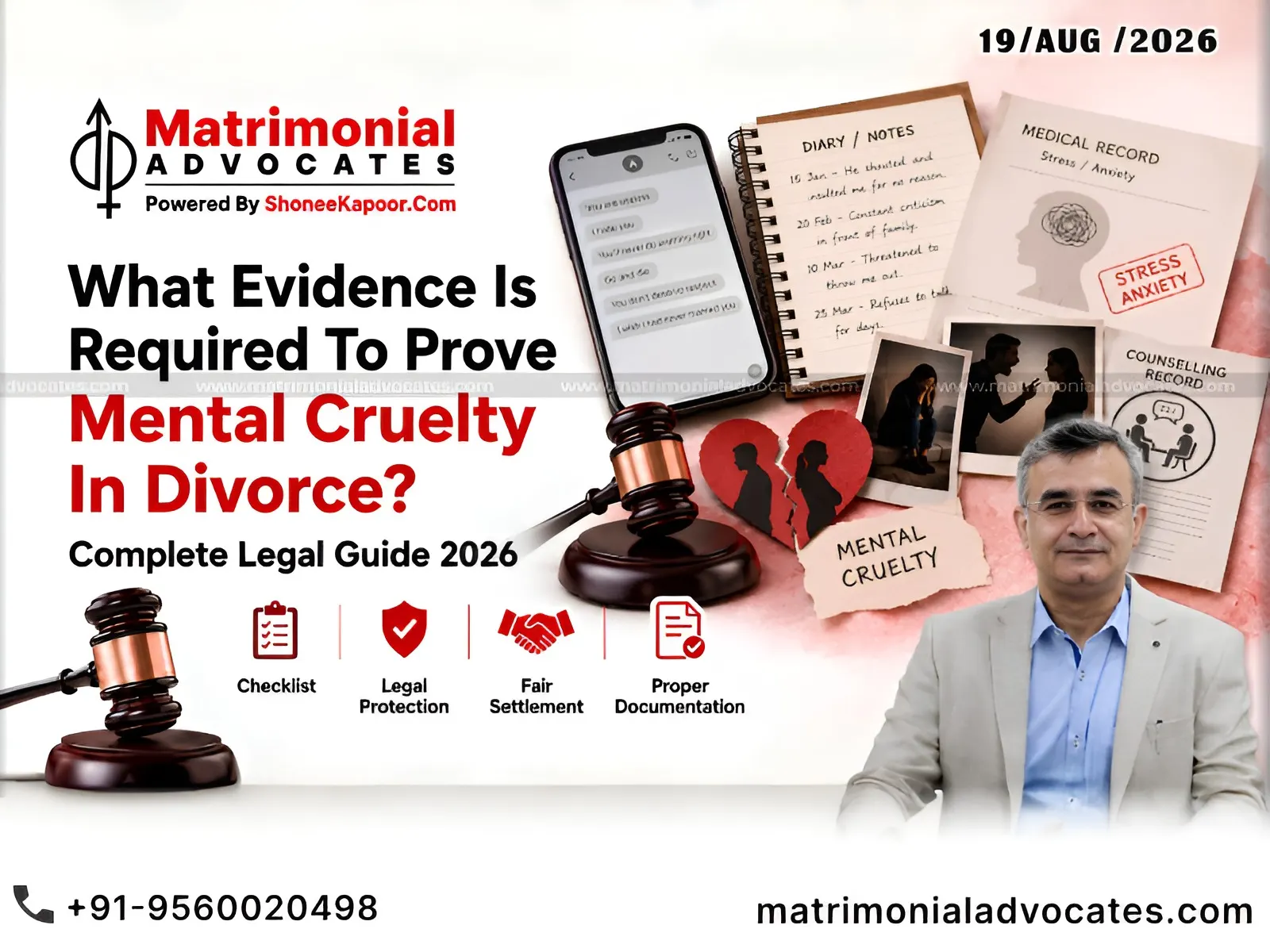
What evidence proves mental cruelty in divorce in India? Know WhatsApp proof, false cases, witnesses, documents and Supreme Court case laws in 2026.
NEW DELHI: “My spouse mentally tortured me throughout the marriage.”
In a divorce case, saying it is easy. Proving it is what matters.
A Family Court does not grant divorce merely because one spouse describes the marriage as toxic, humiliating or unbearable. The court looks for specific incidents, consistent conduct and supporting evidence showing that the cruelty was real and serious enough to affect matrimonial life.
For husbands, this distinction matters even more when the case involves false criminal complaints, defamatory allegations, repeated threats, or litigation used as pressure.
Simply saying, “She filed false cases against me,” will not prove mental cruelty.
The court will look at the FIR, complaints, pleadings, contradictions, judicial orders, cross-examination, admissions, electronic communications and the eventual outcome of those proceedings. In matrimonial litigation, allegations may start the case. Evidence is what proves it.
WHAT IS MENTAL CRUELTY UNDER INDIAN DIVORCE LAW?
For a Hindu marriage, Section 13(1)(ia) of the Hindu Marriage Act, 1955 permits either spouse to seek divorce where the other spouse has, after solemnisation of the marriage, “treated the petitioner with cruelty.” The provision is gender-neutral.
For marriages governed by the Special Marriage Act, Section 27(1)(d) similarly recognises cruelty as a ground for divorce.
The statute deliberately does not provide a mathematical definition of mental cruelty.
The Supreme Court has repeatedly explained why.
In Samar Ghosh v. Jaya Ghosh, principles later reproduced and applied by the Supreme Court in K. Srinivas Rao v. D.A. Deepa, the Court emphasised that married life must be examined as a whole. A handful of isolated incidents spread over years may not necessarily constitute cruelty; the nature, persistence and cumulative effect of the conduct matter.
There is no fixed numerical test for mental cruelty in matrimonial law.
Five abusive messages do not automatically amount to cruelty.
Three police complaints do not automatically prove cruelty.
Even prolonged separation, by itself, may not be enough.
The court examines the nature of the conduct, its seriousness, frequency, surrounding circumstances and cumulative effect on the marriage.
Every marriage has disagreements, arguments and periods of emotional strain. The law does not treat ordinary marital discord as cruelty.
Mental cruelty begins where the conduct goes beyond routine matrimonial wear and tear and becomes persistent, grave or humiliating enough to make continued marital life unreasonable or seriously distressing for the other spouse.
WHAT DOES A PERSON SEEKING DIVORCE ACTUALLY HAVE TO PROVE?
A cruelty petition becomes stronger when it clearly explains what happened, when it happened, and what evidence supports it.
Vague statements such as “she insulted me,” “she threatened me,” or “she filed false cases” are rarely enough on their own. The court will naturally ask: When did it happen? What exactly was said or done? Is there any message, complaint, witness, recording, court document or admission to support it?
This is where many otherwise genuine cases become weak.
A divorce petition does not become stronger merely because it contains dozens of allegations. What matters is whether the important incidents are specifically pleaded and capable of being proved.
In matrimonial litigation, ten well-supported incidents can carry far more weight than fifty vague accusations.
THE STRONGEST EVIDENCE TO PROVE MENTAL CRUELTY
There is no single compulsory document called “proof of mental cruelty.” Depending upon the facts, cruelty may be established through documentary, electronic, oral and circumstantial evidence viewed together.
- WhatsApp chats, emails, SMS and other digital communications
For many modern marriages, some of the best evidence already exists inside the phone.
Relevant material can include:
- abusive or humiliating WhatsApp messages;
- repeated threats;
- emails containing serious accusations;
- messages threatening criminal litigation;
- communications admitting particular incidents;
- messages sent to relatives or third persons;
- social-media communications affecting the spouse’s reputation;
- relevant voice notes; and
- other electronic records connected with the pleaded cruelty.
But there is a difference between possessing a screenshot and proving an electronic record.
The Bharatiya Sakshya Adhiniyam, 2023, which came into force on 1 July 2024, expressly recognises electronic and digital records. Sections 61 and 62 provide for proof of electronic records, while Section 63 prescribes conditions governing computer output and the accompanying certificate.
So do not preserve only three dramatic screenshots and delete everything else.
Preserve, where possible:
- the original device;
- complete conversations rather than selected fragments;
- dates and timestamps;
- exported chats or original files;
- relevant backups;
- information identifying the device/source; and
- the material required for proper electronic-evidence certification.
A cropped screenshot can be challenged.A properly preserved electronic trail is much harder to explain away.
- Police complaints, FIRs and previous court proceedings
This category deserves particular attention in matrimonial litigation.
In K. Srinivas Rao v. D.A. Deepa, the Supreme Court held that making unfounded defamatory allegations in pleadings, issuing material affecting the spouse’s business or employment, and filing repeated false complaints and cases can, depending upon the facts, amount to mental cruelty.
But there is an equally important warning.
The mere filing of a criminal complaint does not automatically prove cruelty.
Nor does every acquittal automatically establish that the complainant committed matrimonial cruelty.
In Mangayakarasi v. M. Yuvaraj, the Supreme Court cautioned against mechanically treating an acquittal in a criminal proceeding as mental cruelty where the cruelty case had not been properly pleaded and established.
Therefore, if a husband relies upon an allegedly false 498A, dowry, domestic-violence or other criminal complaint, collect the entire litigation record:
- complaint/FIR;
- allegations originally made;
- statements where relevant;
- charge-sheet or closure report;
- bail or discharge orders;
- quashing order, if any;
- trial judgment/acquittal, if any;
- contradictory pleadings in connected proceedings;
- admissions made by the spouse; and
- documents demonstrating repetition or escalation of allegations.
Do not tell the court merely that the case was “false”. Show the court why the record establishes it.
- Pleadings and admissions made by the spouse
Sometimes the strongest evidence of cruelty comes from the opposite party during litigation itself.
A written statement, affidavit, maintenance petition, domestic-violence pleading, complaint or cross-examination may contain admissions or serious allegations directly relevant to cruelty.
This is not theoretical.
HOW SUPREME COURT CASES SHOW WHAT AMOUNTS TO MENTAL CRUELTY
In V. Bhagat v. D. Bhagat, (1994) 1 SCC 337, the wife alleged in her written statement that the husband suffered from serious mental problems and required psychiatric treatment. During cross-examination, questions were also put suggesting that members of his family, including his grandfather, were “lunatics.”
The Supreme Court treated such allegations and courtroom conduct as capable of causing serious mental pain and anguish amounting to mental cruelty. This principle was later specifically discussed in K. Srinivas Rao v. D.A. Deepa.
The practical lesson is important: mental cruelty may be proved not only by what happened during the marriage, but also by what a spouse states in pleadings, complaints, affidavits and cross-examination.
Therefore, a matrimonial case should never be examined in isolation. The pleadings in the divorce case should be compared with statements made in maintenance proceedings, DV cases, police complaints, criminal proceedings, custody litigation and affidavits.
A contradiction may look like a small inconsistency. In the right case, it can become crucial evidence of cruelty.
CAN FALSE ALLEGATIONS OF AN AFFAIR AMOUNT TO MENTAL CRUELTY?
Yes: when the allegations are sufficiently serious and unsupported, courts have treated reckless accusations about character or fidelity as cruelty.
In Vijaykumar R. Bhate v. Neela Vijaykumar Bhate, (2003) 6 SCC 334, the Supreme Court, in K. Srinivas Rao, treated allegations concerning unchastity and indecent familiarity with another person in the written statement as having the seriousness and consequence necessary to constitute matrimonial cruelty.
The principle remains very much alive.
In Anupama Sharma v. Sanjay Sharma,2025: DHC:8826-DB, decided on 8 October 2025, the Delhi High Court upheld dissolution of the marriage on cruelty and specifically observed that accusing a spouse of infidelity without particulars, corroboration or proof is inherently cruel.
If such allegations are part of your case, preserve the actual pleading or communication.
Do not merely say:
“My wife questioned my character.”
Produce exactly what was alleged, where it was alleged and whether any evidence was ever offered to substantiate it.
WITNESS EVIDENCE: WHO ACTUALLY SAW OR HEARD THE CRUELTY?
Mental cruelty often happens inside a home, which means independent witnesses may not always exist.
That does not make the case impossible.
The spouses themselves are competent witnesses in civil proceedings under Section 126 of the Bharatiya Sakshya Adhiniyam. Section 128 also expressly creates an exception to the marital-communications restriction in suits between married persons.
Depending upon the incident, other relevant witnesses may include:
- parents or relatives who personally witnessed conduct;
- neighbours;
- friends;
- domestic staff;
- colleagues;
- employers;
- persons present during threats or confrontations; or
- persons directly receiving defamatory complaints or communications.
The key word is personally.
A witness who says, “He told me his wife used to abuse him,” is fundamentally different from one who says, “I was present when this incident occurred.”
First-hand evidence is more valuable than a collection of people repeating what the petitioner told them.
DO MEDICAL OR PSYCHOLOGICAL RECORDS HAVE TO BE PRODUCED?
No universal rule says that a person must undergo psychiatric treatment before mental cruelty can be proved.
Mental cruelty is a matrimonial legal ground. It does not become real only after a psychiatrist issues a certificate.
However, genuine contemporaneous medical material may substantially corroborate the consequences of the conduct where relevant.
For example:
- treatment taken during the disputed period;
- contemporaneous prescriptions;
- hospital records;
- counselling records, subject to applicable confidentiality issues; or
- other medical evidence connected with the pleaded consequences.
Such evidence should support the case.It should not be manufactured merely because litigation has started.
EVIDENCE OF PROFESSIONAL AND REPUTATIONAL DAMAGE
Trying to destroy a spouse professionally can become highly relevant evidence of cruelty.
In Naveen Kohli v. Neelu Kohli, as discussed in K. Srinivas Rao, the Supreme Court considered, among other conduct, newspaper communications affecting the husband’s business relationships while examining mental cruelty. K. Srinivas Rao subsequently recognised that defamatory complaints, notices or news items adversely affecting a spouse’s business or employment may, on the facts of a particular case, amount to cruelty.
If your case involves professional damage, preserve:
- complaint sent to employer;
- email sent to clients;
- letters sent to professional bodies;
- social-media publication;
- disciplinary correspondence triggered by the allegation;
- communication received from employer/client; and
- proof connecting the spouse with the communication.
Again, outrage is not evidence.
The document is evidence.
FAMILY COURTS HAVE A WIDER EVIDENTIARY POWER
Litigants frequently overlook another provision.
Section 14 of the Family Courts Act, 1984 gives a Family Court broad power to receive a report, statement, document, information or other material which, in its opinion, may assist it in effectively dealing with the dispute, even where ordinary evidentiary objections might otherwise arise.
But do not misunderstand this provision.
“Court can receive the material” does not mean “court must believe the material.”
Authenticity, context, credibility, completeness and evidentiary weight remain crucial.
That is why throwing 800 pages of screenshots into a case is not evidence strategy.
Organising the 20 pages that actually prove the pleaded cruelty is.
ELECTRONIC EVIDENCE: THE 2026 MISTAKE TO AVOID
Many old internet articles still casually refer only to Section 65B of the Indian Evidence Act.
For proceedings instituted after the new evidence law came into force, practitioners must account for the Bharatiya Sakshya Adhiniyam, 2023. Section 170 expressly repealed the Indian Evidence Act while saving proceedings already pending at the time of commencement; those proceedings continue under the former Evidence Act.
Therefore, the date and procedural history of the case matter.
For electronic material governed by the new regime, examine Section 63 and its certificate framework.
The practical rule is simple:
Preserve first. Authenticate properly. Produce strategically.
And do not illegally hack a spouse’s phone, email or cloud account in the name of “collecting evidence.” Evidence strategy does not give anyone a licence to commit another legal wrong.
WHAT EVIDENCE IS USUALLY WEAK?
Some material may have limited evidentiary value unless properly corroborated:
- isolated cropped screenshots;
- screenshots with missing dates or identity;
- a diary created only after litigation began;
- hearsay from relatives who witnessed nothing;
- vague allegations without dates or circumstances;
- hundreds of ordinary matrimonial disagreements presented as “cruelty”;
- criminal acquittal treated as automatic proof that the complaint was malicious;
- edited audio/video clips;
- documents whose source cannot be explained; and
- allegations introduced for the first time after the case has substantially progressed.
More evidence does not automatically mean a stronger case.
Sometimes it simply creates more material for cross-examination.
FOR HUSBANDS: BUILD AN EVIDENCE FILE, NOT AN EMOTIONAL FILE
After years of matrimonial conflict, many husbands reach court with a long story but a poorly organised record.
That can be a serious mistake.
Instead of trying to document every argument in the marriage, prepare a clear chronology of the incidents that actually support mental cruelty. Against each important incident, note the date, what happened, the available evidence, any witness and the connected complaint, case or court order.
Keep the important material together: pleadings, FIRs and complaints, court orders, WhatsApp chats, emails, employment-related communications, medical records where relevant, and contradictions or admissions made by the spouse in other proceedings.
This becomes particularly important where cruelty is alleged through false complaints or defamatory litigation. In K. Srinivas Rao v. D.A. Deepa, (2013) 5 SCC 226, the Supreme Court recognised that false complaints and defamatory allegations made during matrimonial litigation can, on the facts of the case, amount to mental cruelty.
Electronic evidence also needs to be preserved properly. Under Section 63 of the Bharatiya Sakshya Adhiniyam, 2023, electronic records such as WhatsApp chats, emails and other computer outputs are subject to specific admissibility requirements, including certification when the provision applies.
One final caution: once matrimonial litigation begins, do not create fresh evidence against yourself through abusive messages, threats or reckless accusations. Courts assess cruelty from the overall conduct and cumulative circumstances of the marriage, not merely from one isolated incident.
Your spouse’s messages may support your cruelty case. Your own messages can weaken it just as quickly.
Build the case around evidence, not anger.
IMPORTANT CASE LAWS ON MENTAL CRUELTY
- Samar Ghosh v. Jaya Ghosh, (2007) 4 SCC 511
The Supreme Court held that no uniform or exhaustive formula can define mental cruelty. The entire matrimonial relationship must be examined, including the nature, duration and cumulative effect of the conduct complained of. - Bhagat v. D. Bhagat, (1994) 1 SCC 337
Serious allegations regarding the husband’s mental condition, coupled with offensive suggestions made during cross-examination about members of his family, were held to constitute mental cruelty causing immense mental pain and anguish. - Vijaykumar R. Bhate v. Neela Vijaykumar Bhate, (2003) 6 SCC 334
The Supreme Court held that serious allegations of unchastity and improper relationship with another person, made in matrimonial pleadings, could amount to mental cruelty because of their gravity and lasting impact on the spouse. - Naveen Kohli v. Neelu Kohli, (2006) 4 SCC 558
The Court considered repeated litigation, complaints and conduct affecting the husband’s business and reputation while holding that the cumulative conduct amounted to mental cruelty. - Srinivas Rao v. D.A. Deepa, (2013) 5 SCC 226
The Supreme Court held that unfounded defamatory allegations, repeated false complaints and attempts to damage a spouse’s employment or reputation can, depending on the facts, amount to mental cruelty. - Mangayakarasi v. M. Yuvaraj, Civil Appeal Nos. 1912–1913 of 2020, decided on 3 March 2020
The Supreme Court cautioned that a criminal acquittal cannot automatically be converted into a finding of matrimonial cruelty. Cruelty relied upon for divorce must be properly pleaded, supported by evidence and established on the facts of the matrimonial case. - Anupama Sharma v. Sanjay Sharma, MAT.APP.(F.C.) 142/2022, 2025:DHC:8826-DB, decided on 8 October 2025
The Delhi High Court upheld divorce on the ground of cruelty where the wife had made unsubstantiated allegations of infidelity against the husband. The Court treated such serious allegations, when unsupported by particulars or proof, as matrimonial cruelty.
CAN MENTAL CRUELTY BE PROVED WITHOUT A VIDEO OR RECORDING?
Absolutely.
No law requires that every cruel act be recorded on a mobile phone.
Most marriages existed long before spouses started preparing evidence against one another.
Mental cruelty can emerge from the cumulative effect of:
- credible oral testimony;
- contemporaneous correspondence;
- pleadings;
- complaints;
- admissions;
- court records;
- witness evidence;
- surrounding circumstances; and
- consistent conduct over time.
The Supreme Court’s approach requires viewing the matrimonial relationship as a whole, rather than reducing cruelty to one isolated document.
What matters is whether the evidence, taken together, proves the legal ground relied upon.
CONCLUSION
Mental cruelty is not proved by making more allegations. It is proved by presenting clear, consistent and credible evidence.
If the cruelty involves false complaints, produce the complaints, court records, contradictions and final orders. If it happened through WhatsApp or email, preserve the complete electronic record. If defamatory allegations were made before a court or employer, place those documents on record. If someone personally witnessed the conduct, identify that witness.
A Family Court is not expected to accept an allegation merely because it is repeated strongly.
The better approach is to build a record that speaks for itself.
There is a significant difference between suffering mental cruelty and successfully proving it in court. In a divorce case, the allegation begins the story. Evidence decides the case.
FAQs
- What is the strongest evidence of mental cruelty in divorce?
WhatsApp chats, emails, complaints, court records, admissions and credible witness testimony can strongly support a cruelty claim. - Can WhatsApp chats prove mental cruelty?
WhatsApp chats can be relied upon if their authenticity and electronic-evidence requirements are properly established. - Does a false 498A or DV case amount to mental cruelty?
It can, if the complaint is shown to be false or malicious. Mere filing of a case or subsequent acquittal is not automatically cruelty. - Are medical records necessary to prove mental cruelty?
Medical records can support the case, but they are not compulsory for proving mental cruelty. - Can false allegations made in court amount to mental cruelty?
Serious and unsubstantiated allegations about character, fidelity or conduct can themselves amount to mental cruelty.