
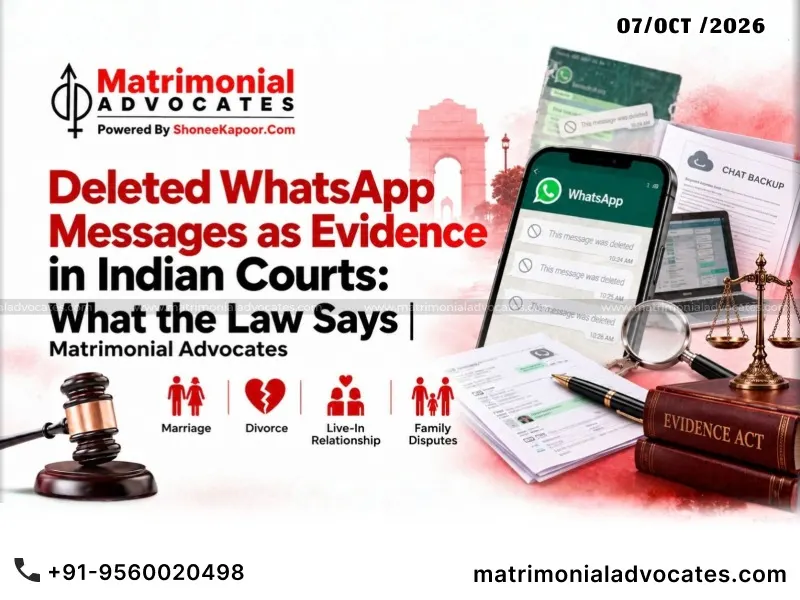
Can deleted WhatsApp chats, screenshots or “This message was deleted” still prove a case? Here is what Indian law says about recovering, authenticating and using WhatsApp evidence in court.
NEW DELHI: A WhatsApp message is sent. Minutes later, it is deleted. By the time the dispute reaches court, only “This message was deleted” remains.
In matrimonial cases, that one deleted message may have contained a threat, an admission, a demand, an apology or a statement capable of changing the entire case.
But does deleting a WhatsApp message also delete its evidentiary value?
Not necessarily.
A deleted message may still leave behind a recipient’s copy, backup, screenshot, connected conversation, forensic trace or other supporting evidence. At the same time, merely producing a screenshot or claiming that a deleted chat has been “recovered” does not make it legally proven.
The real questions before a court are far more important:
Who sent the message? What exactly was said? Is the record complete? Has it been altered? How was it preserved or recovered? And can its authenticity and integrity be established under the law governing electronic evidence?
In digital litigation, finding the message is only the first step.
Proving it is what decides the case.
CAN DELETED WHATSAPP MESSAGES BE USED AS EVIDENCE IN INDIA?
Yes. Deleted WhatsApp messages may still be used as evidence in Indian courts if a reliable form of the communication survives and its authenticity can be established under the law governing electronic evidence.
Deletion does not always mean that the communication has disappeared completely.
A sender may delete a message only from his or her own device while the recipient still retains it. A message deleted “for everyone” may leave behind the notification “This message was deleted”. A backup created before deletion may still contain the conversation. In a WhatsApp group, another participant may have retained the message. In suitable cases, relevant data may also be obtained through lawful forensic examination of a device.
WhatsApp itself distinguishes between Delete for Me and Delete for Everyone. Deleting a message from one device does not automatically erase copies already available with other participants.
The important legal principle is simple:
Deletion does not necessarily destroy the evidence. But whatever survives must still be properly proved before the court.
A screenshot, backup or recovered chat is not automatically accepted merely because it appears to show a WhatsApp conversation. The court may still examine its source, authenticity, completeness and integrity.
Does “This message was deleted” prove the contents of a WhatsApp message?
No.
If a WhatsApp chat displays only “This message was deleted”, it may indicate that a message was removed from that point in the conversation.
However, the deletion marker by itself does not prove what the deleted message actually contained.
For example, suppose a husband alleges that his wife sent the message:
“I will file a false case unless you transfer money.”
If the only surviving record shows “This message was deleted”, the court cannot simply presume that these were the words contained in the deleted message.
The alleged contents would ordinarily require supporting material such as:
- the recipient’s surviving copy of the message;
- a screenshot taken before deletion;
- an existing backup of the chat;
- the same message retained on another participant’s device;
- a lawfully obtained forensic extraction;
- surrounding messages that clearly explain the deleted communication;
- an admission by the sender; or
- other credible corroborative evidence.
This distinction becomes especially important in matrimonial disputes, where a deleted message may be relied upon to support allegations of cruelty, threats, harassment, adultery, financial demands or false-case threats.
The court does not decide what a deleted message probably said.
It decides what the evidence can actually prove.
DELETED WHATSAPP MESSAGES AS ELECTRONIC EVIDENCE UNDER THE BHARATIYA SAKSHYA ADHINIYAM, 2023
This is where many online articles are already out of date.
The Bharatiya Sakshya Adhiniyam, 2023 (BSA) came into force on 1 July 2024.
Section 61 states that an electronic or digital record cannot be denied admissibility merely because it is electronic or digital. Subject to Section 63, it has the same legal effect, validity and enforceability as other documents.
Section 62 directs that the contents of electronic records are to be proved in accordance with Section 63.
Section 63 then lays down the statutory framework governing computer output, including electronic records printed, copied, stored or recorded from computers and communication devices.
For WhatsApp evidence in Indian courts, this makes one point very clear:
A screenshot being visible on a mobile phone does not exempt it from the law governing electronic evidence.
SECTION 63 CERTIFICATE FOR WHATSAPP AND ELECTRONIC EVIDENCE UNDER THE BHARATIYA SAKSHYA ADHINIYAM, 2023
The certificate required under Section 63(4) of the Bharatiya Sakshya Adhiniyam, 2023 is more detailed than simply renaming the old Section 65B certificate.
The Schedule to the BSA prescribes two parts for certification of electronic records.
Part A is to be completed by the party producing the electronic record. It requires particulars about the electronic record, the device or source from which it was produced and, where applicable, the hash value used to establish its digital integrity.
Part B is to be completed by an expert and also covers the electronic source, device particulars, and hash value.
This framework became particularly important after the Supreme Court’s decision in Pune Bar Association v. Union of India, W.P.(C) No. 599/2026
The challenge before the Court was that requiring hash values and expert certification placed an excessive burden on ordinary litigants producing electronic evidence.
The Supreme Court rejected the challenge.
The Court described the hash value as an “electronic fingerprint” and observed that expert certification under Part B provides an “additional layer of authenticity” to secondary electronic evidence. It held that these requirements are directly connected with verifying the authenticity and integrity of digital records.
This is particularly significant in cases involving deleted WhatsApp messages, recovered chats, screenshots, exported conversations, and forensic extractions.
If a party claims that a deleted WhatsApp conversation has been recovered, the court is entitled to ask:
Was this the actual data recovered from the device, or could it have been altered after recovery?
That is precisely where hash values, source identification and proper certification become important.
For digital evidence, authenticity is no longer a minor technical formality.
It can determine whether a WhatsApp chat is treated as reliable electronic evidence or successfully challenged in court.
WHAT LAW APPLIES TO OLDER CASES: SECTION 65B OF THE INDIAN EVIDENCE ACT OR SECTION 63 OF THE BSA?
Section 63 of the Bharatiya Sakshya Adhiniyam, 2023 does not automatically apply to every pending matrimonial case involving WhatsApp chats or other electronic evidence.
Although the BSA repealed the Indian Evidence Act, 1872, Section 170 contains a savings clause for proceedings that were already pending before the new law came into force. Such matters may therefore continue to be governed by the Indian Evidence Act, including Section 65B for electronic evidence.
For these older proceedings, the leading Supreme Court judgment remains Arjun Panditrao Khotkar v. Kailash Kushanrao Gorantyal, (2020) 7 SCC 1. The Supreme Court reaffirmed that where a party relies upon secondary electronic evidence, the certificate contemplated under Section 65B is ordinarily a condition precedent to admissibility, subject to the principles laid down in the judgment. The Court also distinguished cases where the original electronic device itself is produced and proved by the person who owns or operates it.
Therefore, before relying on WhatsApp chats, screenshots, emails, call records or other digital evidence, it is essential to first determine when the proceeding began and which evidence law governs it.
A case governed by the old Evidence Act may require compliance with Section 65B, while a proceeding governed by the BSA must satisfy Section 63.
That distinction may appear technical, but getting it wrong can create a serious objection to the admissibility of otherwise important electronic evidence.
WHY A WHATSAPP SCREENSHOT ALONE MAY NOT PROVE THE CHAT
A WhatsApp screenshot can show what appeared on a screen at a particular point in time, but that does not automatically prove the entire conversation or establish who actually sent the messages.
The opposing party can still dispute ownership of the WhatsApp number, the sender’s identity, the conversation’s completeness, the presence of deleted messages, the screenshot’s source, and whether the image has been edited or selectively cropped. Even the name appearing at the top of a WhatsApp chat may simply be the contact name saved by the person taking the screenshot.
This is why cropped or isolated WhatsApp screenshots can be particularly vulnerable when relied upon as evidence. The original device, surrounding conversation, metadata, and how the screenshot or printout was produced can become important in establishing authenticity and context.
The Supreme Court recognised this issue in Ambalal Sarabhai Enterprise Ltd. v. KS Infraspace LLP Ltd., Civil Appeal No. 9346 of 2019, decided on 6 January 2020, where WhatsApp messages were described as “virtual verbal communications” whose contents and meaning are matters of evidence and may have to be understood together with the surrounding communications.
That principle is important in matrimonial litigation as well.
A single screenshot may appear damaging when viewed in isolation, while the messages immediately before or after it may completely change its meaning.
In WhatsApp evidence, context is often as important as content.
WHAT THE SUPREME COURT’S 2021 OBSERVATION ON WHATSAPP EVIDENCE REALLY MEANS
In 2021, a Supreme Court observation on WhatsApp messages was widely reported after the Court remarked:
“Anything can be created and deleted on social media these days.”
The observation arose during a commercial dispute and reflected the Court’s concern about blindly relying on digital communications without examining their authenticity. It should not be read as a blanket rule that WhatsApp chats have no evidentiary value or can never be admitted in Indian courts.
The legal position is more nuanced.
WhatsApp chats, screenshots and other electronic communications can form part of evidence, but their value depends on whether they are relevant to the dispute, attributable to the alleged sender, authentic, complete and proved in accordance with the applicable law on electronic evidence.
Subsequent statutory developments and judicial decisions have further clarified this position. Courts do not automatically accept WhatsApp material merely because it appears on a screen, but they do not reject it merely because it is digital either.
The real issue is not whether the evidence came from WhatsApp.
The real issue is whether the WhatsApp evidence can be reliably proved.
DELHI HIGH COURT ON DELETED WHATSAPP MESSAGES: WHEN DELETION ITSELF BECOMES RELEVANT
An important judgment on the evidentiary significance of deleted WhatsApp messages is Praveen Kumar Malhotra v. Arun Kumar, RC.REV. 331/2023, decided on 12 February 2024.
The Delhi High Court examined a WhatsApp conversation in which some messages remained visible while three particular messages had been deleted. Significantly, the person concerned admitted deleting those messages but could not satisfactorily explain why only those communications were removed while the surrounding messages remained intact.
The Court did not treat the deleted messages in isolation. It considered the admission of deletion, the surviving conversation and the surrounding circumstances together while drawing its inference on the facts of the case.
This judgment does not mean that every deleted WhatsApp message will automatically be presumed against the person who deleted it.
Its real significance is narrower and more important:
Selective deletion can itself become a relevant evidentiary circumstance when it is supported by admissions, surrounding messages and other material on record.
In other words, deletion may not prove the exact contents of a missing message, but in the right factual context, it can still become part of the court’s evidentiary assessment.
CAN DELIBERATE DELETION LEAD TO AN ADVERSE INFERENCE?
Potentially, yes.
Section 119 of the Bharatiya Sakshya Adhiniyam allows a court to presume certain facts based on ordinary human conduct and surrounding circumstances.
Illustration (g) specifically permits the court to presume that evidence which could be produced but is withheld would, if produced, be unfavourable to the person withholding it.
The principle is discretionary, not automatic.
Under the earlier Evidence Act, the Supreme Court in Tomaso Bruno v. State of U.P., (2015) 7 SCC 178 explained that withholding the best available electronic evidence can justify an adverse inference depending upon factors such as the nature, importance, accessibility and quality of the evidence withheld.
Therefore, merely shouting “she deleted the chats” will prove nothing.
You first need material showing that relevant evidence existed, that the person had access or control over it, and that the circumstances justify the inference sought.
FAMILY COURTS HAVE WIDER POWERS TO CONSIDER WHATSAPP AND ELECTRONIC EVIDENCE
Section 14 of the Family Courts Act, 1984 gives Family Courts wider flexibility to receive reports, statements, documents and other material that may help decide a matrimonial dispute, even where ordinary evidentiary objections may arise.
But there is an important distinction:
Receiving electronic material does not mean the court must accept it as true.
The Family Court can still examine its authenticity, relevance, privacy concerns and evidentiary weight.
In Smt. Anjali Sharma v. Raman Upadhyay, Misc. Petition No. 3395/2023, decided on 16 June 2025, the Madhya Pradesh High Court, while dealing with WhatsApp material in a matrimonial dispute, recognised the broad scope of Section 14 and the discretion available to Family Courts.
The practical position is clear: WhatsApp chats may reach the court more easily, but they must still withstand scrutiny before they can influence the final decision.
SUPREME COURT ON SECRETLY RECORDED SPOUSAL CONVERSATIONS IN MATRIMONIAL CASES
In Vibhor Garg v. Neha, 2025 INSC 829, the Supreme Court examined whether a husband could rely on secretly recorded conversations with his wife in divorce proceedings.
The Court held that such recordings cannot be excluded merely because they were made without the other spouse’s knowledge or consent. It reiterated that recorded conversations must satisfy the three-fold test of relevance, identification and accuracy before they can be relied upon.
The judgment is important because it makes clear that privacy concerns do not automatically bar relevant electronic evidence in matrimonial litigation.
However, the ruling does not authorise hacking or unauthorised access to a spouse’s phone, WhatsApp account, email or cloud storage. The legality of how the evidence was obtained can still raise separate issues.
The practical takeaway is simple: relevant electronic evidence may be considered, but how it is obtained and proved still matters.
RAJASTHAN HIGH COURT ON WHATSAPP CHATS IN ADULTERY AND CRUELTY CASES
In Kailash Menaria v. Yashoda Menaria, 2026:RJ-JD:23340, decided on 6 May 2026, the husband sought to rely on WhatsApp chats and call detail records in matrimonial proceedings alleging cruelty and adultery.
The Family Court declined to exhibit the material, citing the absence of a Section 65B certificate and privacy concerns.
The Rajasthan High Court took a broader view and emphasised that relevant electronic material should not be shut out mechanically where it may assist the court in deciding the matrimonial dispute. At the same time, such material must still satisfy the applicable requirements of electronic evidence and withstand scrutiny on authenticity, privacy and evidentiary value.
The principle is straightforward:
Relevance may allow WhatsApp evidence to enter the case, but proper proof determines the weight the court ultimately gives it.
BOMBAY HIGH COURT: WHATSAPP CHATS ALONE CANNOT PROVE CRUELTY OR SECURE DIVORCE
In Supriya Gaurav Devare v. Gaurav Jitendra Patil, 2026:BHC-AS:10374-DB, an ex parte divorce decree had substantially relied on WhatsApp and SMS chats allegedly showing cruelty by the wife.
The Bombay High Court set aside the decree and remanded the matter, stressing that electronic conversations cannot substitute for proper proof.
The Court observed:
“Merely relying on the WhatsApp Chat, the divorce decree cannot be granted, since it is not proved by leading evidence.”
The judgment reinforces an important rule for matrimonial cases: WhatsApp chats may support an allegation, but they do not prove cruelty merely because they have been placed before the court. Their authenticity, context and evidentiary value must still be established.
In simple terms, a WhatsApp chat may be part of the evidence, but it cannot become the entire case by itself.
CAN WHATSAPP OR META GIVE YOU THE DELETED MESSAGE?
Do not build litigation strategy on the assumption that a court can simply ask WhatsApp to produce the readable contents of every deleted personal message.
WhatsApp states that personal messages and calls are protected by end-to-end encryption, meaning WhatsApp or Meta cannot read their content in the ordinary course.
Depending upon the facts, lawful requests may concern account information or other records that actually exist and can legally be supplied.
But for the contents of a deleted personal chat, the more realistic evidentiary sources may be:
- the recipient’s device;
- another participant’s device;
- an existing backup;
- a saved photograph, document or media file;
- a contemporaneous screenshot or export;
- connected emails or messages;
- admissions; or
- lawful forensic examination of an available device.
Do not confuse “a court can order production of evidence” with “WhatsApp necessarily possesses a readable copy of every deleted conversation.”
WHAT SHOULD A HUSBAND DO IF IMPORTANT WHATSAPP MESSAGES ARE BEING DELETED?
If important WhatsApp messages are being deleted during a matrimonial dispute, the first priority should be preservation, not experimentation.
Where relevant chats still exist on your phone, preserve the original device, complete conversation, phone number or profile details, dates and timestamps, media, voice notes, lawful backups and surrounding messages. Avoid cropping, editing or repeatedly forwarding the only available copy, as this may create unnecessary questions about authenticity and context.
If messages have already been deleted, preserve whatever remains and consider obtaining proper legal or forensic assistance before altering the device. Do not attempt to hack, secretly access or bypass passwords protecting another person’s WhatsApp account, email or cloud storage merely to obtain evidence.
In matrimonial litigation, potentially valuable evidence can quickly lose its usefulness if you cannot later establish its source or integrity.
A husband may know exactly what happened. But in court, what matters is what he can legally and reliably prove.
CONCLUSION
Deleted WhatsApp messages can still become important evidence in matrimonial disputes if some reliable record of the communication survives and can be properly proved.
A screenshot, backup, recovered chat or deletion marker may support a case, but the court will still examine authenticity, context, source, integrity and compliance with the applicable law on electronic evidence.
The key is not merely recovering a message. It is showing the court that the digital record is genuine, complete and legally reliable.
In electronic evidence, preservation matters. But proof matters more.
FAQs
- Can deleted WhatsApp messages still be used in court?
If a reliable copy, backup or forensic record survives, it may still be used as electronic evidence. - Does “This message was deleted” prove what was written?
It may show deletion, but not the actual contents of the deleted message. - Is a WhatsApp screenshot enough to prove a divorce case?
Not by itself. The court may still examine authenticity, authorship, context and legal compliance. - Can deleting WhatsApp chats backfire in court?
Yes, in some cases. Selective or unexplained deletion may become a relevant circumstance against a party. - Can a husband use his wife’s WhatsApp chats in Family Court?
Potentially, yes. But the chats must be relevant, lawfully obtained and properly proved.