

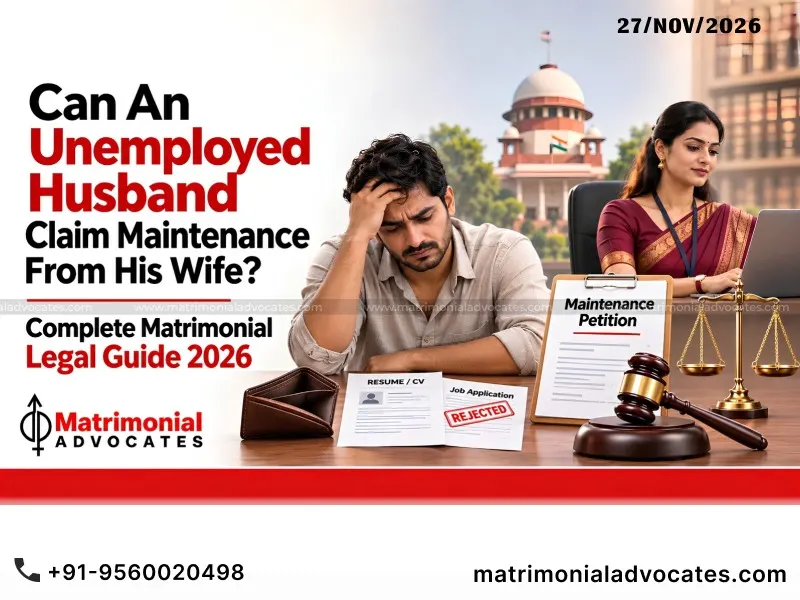
Understand an unemployed husband’s maintenance rights in India under Sections 24 and 25 of the Hindu Marriage Act, eligibility and landmark court judgments.
NEW DELHI: Marriage creates financial responsibilities for both spouses. However, when a marriage breaks down, maintenance is often seen as an obligation imposed exclusively on the husband.
But what happens when the husband loses his job, suffers from a serious illness, becomes financially dependent or earns substantially less than his wife? Can he approach the Family Court and demand maintenance from her?
The answer is yes, subject to certain legal conditions.
The Hindu Marriage Act, 1955, recognises husbands’ right to claim interim maintenance, litigation expenses, and permanent alimony from their wives. However, judicial interpretation, earning capacity and financial evidence play a decisive role in determining whether such relief will actually be granted.
CAN A HUSBAND LEGALLY CLAIM MAINTENANCE FROM HIS WIFE IN INDIA?
Indian matrimonial laws are not entirely gender-neutral when it comes to maintenance. While several statutory provisions exclusively recognise the wife’s right to spousal maintenance, the Hindu Marriage Act provides certain financial remedies to both spouses.
An unemployed husband can approach the competent matrimonial court if he does not have sufficient independent income to maintain himself or meet the necessary expenses of matrimonial litigation.
Importantly, a husband does not necessarily have to be completely unemployed to invoke these provisions. Insufficient independent income may also provide grounds for seeking financial assistance.
However, merely establishing that the wife earns more than her husband does not automatically entitle him to maintenance.
LEGAL PROVISIONS ALLOWING HUSBANDS TO CLAIM MAINTENANCE
Section 24 of the Hindu Marriage Act, 1955
Section 24 HMA provides for maintenance pendente lite, commonly known as interim maintenance, and expenses of matrimonial proceedings.
Either spouse can file an application under this provision during pending matrimonial proceedings under the Act, including proceedings for:
- Contested divorce.
- Restitution of conjugal rights.
- Judicial separation.
- Annulment of marriage.
A financially dependent husband may seek monthly maintenance to meet reasonable living expenses and financial assistance towards conducting matrimonial litigation.
The court considers the independent income of both parties, their financial circumstances, and the applicant’s reasonable requirements.
The provision also requires the court, as far as possible, to decide the maintenance application within 60 days of service of notice on the other spouse.
The objective is to ensure that financial inequality does not deprive either spouse of the opportunity to pursue or defend matrimonial proceedings.
Section 25 of the Hindu Marriage Act, 1955
Section 25 HMA empowers matrimonial courts to grant permanent alimony and maintenance to either the husband or the wife.
An application may be made at the time of passing a matrimonial decree or subsequently.
The court may direct payment through a lump-sum settlement or monthly or periodic payments for a period not exceeding the applicant’s lifetime.
While determining permanent alimony, the court considers:
- Income and property of both spouses.
- Financial dependency and reasonable requirements.
- Conduct of the parties.
- Other relevant circumstances of the case.
Unlike interim maintenance under Section 24, permanent alimony under Section 25 can continue beyond the conclusion of matrimonial proceedings.
Under Section 25(2), the court may subsequently modify or rescind the order if the circumstances of either party materially change.
WHEN CAN AN UNEMPLOYED HUSBAND SUCCESSFULLY CLAIM MAINTENANCE?
The success of a husband’s maintenance application depends significantly upon the reasons behind his financial dependency.
Genuine loss of employment
A husband who has been retrenched, terminated or rendered unemployed due to business closure may seek maintenance.
However, he must establish the genuineness of his financial hardship through documentary evidence. Courts may also examine his professional qualifications, previous income, available assets and efforts to secure alternative employment.
A temporary loss of employment alone may not be sufficient.
Physical disability or serious illness
A husband suffering from a physical disability, chronic medical condition or serious mental illness that substantially affects his earning capacity may have stronger grounds for claiming maintenance.
Medical certificates, disability assessments, treatment records and evidence of expenditure can help establish genuine financial dependency.
Husband earning substantially less than his wife
Section 24 HMA does not require the applicant to have absolutely no income. The statutory requirement is that the independent income must be insufficient for reasonable support and necessary litigation expenses.
Therefore, a husband earning significantly less than his wife may seek relief if he can establish genuine financial insufficiency.
Nevertheless, maintenance is not a mechanism for automatically equalising spouses’ salaries.
Husband who sacrificed his career for family responsibilities
A husband who discontinued employment to undertake childcare, manage household responsibilities, or support his wife’s professional career may rely on these circumstances when claiming maintenance.
However, such arrangements do not create an automatic entitlement. The court will examine his current financial situation, employment history, and earning capacity.
WHEN CAN A COURT REJECT A HUSBAND’S MAINTENANCE CLAIM?
Courts generally discourage financially capable individuals from deliberately remaining dependent upon their spouses.
A husband’s maintenance claim may be rejected where:
- He voluntarily resigns to create artificial financial dependency.
- He deliberately refuses reasonable employment opportunities.
- He conceals business income, rental income or investments.
- He possesses sufficient financial resources to maintain himself.
- His alleged illness or disability remains unsupported by evidence.
- His application appears to be an attempt to counter his wife’s maintenance proceedings without genuine financial grounds.
Being unemployed and being incapable of earning are two different circumstances. Courts frequently examine this distinction while deciding maintenance claims filed by husbands.
LANDMARK INDIAN JUDGMENTS ON MAINTENANCE TO HUSBANDS
Case: Rani Sethi v. Sunil Sethi (2011) – Delhi High Court
Wife directed to pay ₹20,000 monthly maintenance to husband.
The husband sought interim maintenance under Section 24 HMA after matrimonial differences arose between the parties.
The wife had substantial income from a business the couple had originally established jointly. The husband subsequently attempted to establish another business, which proved unsuccessful.
The trial court directed the wife to pay ₹20,000 monthly maintenance and ₹10,000 towards litigation expenses. She was also directed to provide a Maruti Zen car for the husband’s use.
The wife challenged the order before the Delhi High Court.
On 31 March 2011, Justice G.S. Sistani dismissed her petition, holding that the financial records demonstrated substantial income from her business.
The Court explained that maintenance should provide reasonable financial support, not merely enable the dependent spouse to survive.
Legal significance: A financially dependent husband can obtain maintenance from his wife when the financial circumstances justify such relief.
Case: Bhagyashri Jaiswal v. Jagdish Sajjanlal Jaiswal (2022) – Bombay High Court
Working wife directed to maintain husband even after divorce.
Following the dissolution of their marriage, the husband sought permanent alimony from his former wife, who was employed as a teacher.
He claimed ₹15,000 monthly maintenance. During the pendency of the permanent alimony proceedings, the lower court awarded him ₹3,000 monthly interim maintenance.
Following non-payment, the court also directed deductions of ₹5,000 from the wife’s salary towards outstanding maintenance.
The wife challenged these orders, questioning their maintainability after divorce.
The Bombay High Court upheld the orders on 15 March 2022, recognising that the jurisdiction to grant permanent alimony under Section 25 HMA extends to either spouse.
Legal significance: Divorce does not automatically extinguish a husband’s statutory right to seek permanent alimony from his former wife.
Case: N. Girish v. M. Kusuma (2023) – Karnataka High Court
The able-bodied husband’s ₹2 lakh monthly maintenance claim was rejected.
The husband claimed that he had lost his employment during the COVID-19 pandemic and had no sufficient income to maintain himself.
While the wife sought ₹25,000 monthly maintenance, the husband filed a counter-application demanding ₹2 lakh monthly maintenance and ₹30,000 towards litigation expenses.
The Family Court rejected his application and awarded the wife ₹10,000 monthly maintenance and ₹25,000 towards litigation expenses.
The husband challenged the decision before the Karnataka High Court.
On 10 January 2023, Justice M. Nagaprasanna refused to interfere with the order, observing that granting maintenance to an able-bodied husband without any impediment to earning could encourage idleness.
The Court remarked:
“It is better to wear out, than rust out.”
Legal significance: Although Section 24 is gender-neutral, an unemployed husband must establish that his financial dependency is genuine and justified.
Case: Kanchan v. Kamalendra Sawarkar (1992) – Bombay High Court
Closure of husband’s business held insufficient to justify maintenance.
The husband sought interim maintenance from his employed wife after his business had closed.
The Bombay High Court observed that the husband was physically and mentally capable of earning and possessed the skills necessary to support himself.
The Court set aside the maintenance order passed in his favour, reasoning that granting financial support to an able-bodied person without a genuine impediment to earning would encourage unnecessary dependency.
Legal significance: Business losses or unemployment may not independently establish entitlement to maintenance. Earning capacity remains an important consideration.
Sukhdev Singh v. Sukhbir Kaur (2025) – Supreme Court
Maintenance can be claimed even where a marriage is declared void.
In its judgment dated 12 February 2025, reported as 2025 INSC 197, a three-judge Supreme Court Bench clarified the applicability of Sections 24 and 25 HMA to void marriages.
The Court held that a spouse whose marriage has been declared void under Section 11 HMA can seek permanent alimony under Section 25.
It further clarified that interim maintenance under Section 24 may be granted during pending matrimonial proceedings even where the marriage appears to be void or voidable, provided the statutory requirements are satisfied.
The grant of maintenance remains discretionary and depends upon the circumstances and conduct relevant to the claim.
Legal significance: The judgment clarifies the scope of maintenance remedies available to either spouse, including husbands, in proceedings concerning void marriages.
Case:Sudarshan Kannoujia v. Reema Kannoujia (2026) – Allahabad High Court
Unemployment and illness claims unsupported by evidence rejected.
The husband challenged an order directing him to pay his wife ₹3,000 in monthly interim maintenance.
He argued that he was unemployed due to ill health and that his wife, who possessed a law degree, had independent sources of income.
However, he failed to produce medical documents establishing his illness or sufficient evidence demonstrating his wife’s alleged earnings.
On 17 July 2026, the Allahabad High Court dismissed his appeal and upheld the maintenance order.
Legal significance: Mere allegations of unemployment, illness or a wife’s financial independence cannot substitute for credible documentary evidence.
CAN A HUSBAND CLAIM MAINTENANCE UNDER SECTION 144 BNSS?
No. Section 144 of the Bharatiya Nagarik Suraksha Sanhita, 2023, which corresponds to the erstwhile Section 125 CrPC, provides maintenance remedies for eligible wives, children and parents.
It does not recognise a husband’s right to claim maintenance from his wife as a spouse.
This creates an important statutory distinction between maintenance remedies under the Hindu Marriage Act and those available under criminal procedural law.
| Legal Provision | Husband’s Right to Spousal Maintenance |
| Section 24 HMA, 1955 | Available – Interim maintenance and litigation expenses for either spouse. |
| Section 25 HMA, 1955 | Available – Permanent alimony and maintenance for either spouse. |
| Section 144 BNSS, 2023 | Not available – Covers wives, children and parents, but excludes husbands as spouses. |
| Section 125 CrPC, 1973 | Not available – Recognises wives, children and parents as eligible claimants, but not husbands. |
| Section 20, Domestic Violence Act, 2005 | Not available – Only women qualify as aggrieved persons under the Act. |
| Section 18 HAMA, 1956 | Not available – Exclusively recognises a Hindu wife’s right to maintenance from her husband. |
| Sections 36 and 37, Special Marriage Act, 1954 | Not available – Interim maintenance and permanent alimony provisions exclusively benefit wives. |
The applicable marriage law must therefore be identified before initiating maintenance proceedings.
HOW MUCH MAINTENANCE CAN A HUSBAND CLAIM FROM HIS WIFE?
Sections 24 and 25 of the HMA prescribe no fixed percentage, minimum amount, or universal formula.
In Rajnesh v. Neha, (2021) 2 SCC 324, the Supreme Court laid down comprehensive guidelines for determining maintenance and directed financial disclosures by parties.
Relevant considerations include:
- Actual income and financial resources.
- Standard of living during marriage.
- Reasonable living and medical expenses.
- Educational qualifications and employment circumstances.
- Financial liabilities and dependent family members.
- Capacity of the other spouse to provide financial assistance.
The objective of maintenance is to provide reasonable financial support, not to punish the earning spouse or unjustly enrich the dependent spouse.
HOW CAN AN UNEMPLOYED HUSBAND PROVE HIS MAINTENANCE CLAIM?
Documentary evidence can significantly influence the outcome of maintenance litigation.
A husband seeking maintenance should preserve:
- Employment records: Termination letters, retrenchment notices and previous salary slips.
- Financial documents: Bank statements, income tax returns, investments and loan records.
- Medical evidence: Treatment records, disability certificates and medical expenditure.
- Employment efforts: Job applications, interview communications and rejection letters.
- Wife’s income details: Legally obtained salary records, business information and property details.
- Monthly expenditure: Rent, food, medical costs and reasonable litigation expenses.
Where relevant financial information is exclusively in the wife’s possession, the husband may request appropriate disclosure orders from the court.
Concealing income or exaggerating financial hardship can seriously undermine the credibility of his application.
CAN AN UNEMPLOYED HUSBAND STOP PAYING MAINTENANCE TO HIS WIFE?
No. Losing employment does not automatically suspend or terminate an existing maintenance order.
A husband experiencing a genuine change in financial circumstances should approach the competent court seeking modification or reduction of maintenance.
Depending upon the original proceedings, the applicable remedies may include:
- Section 146 BNSS: Alteration of maintenance allowance.
- Section 127 CrPC: Modification in applicable older proceedings.
- Section 25(2) HMA: Modification of permanent alimony.
- Section 25(2) DV Act: Alteration, modification or revocation of orders due to changed circumstances.
For interim maintenance under Section 24 HMA, an appropriate modification application may be moved before the matrimonial court.
Until the court grants appropriate relief, the existing maintenance order ordinarily remains enforceable.
HOW TO FILE A MAINTENANCE APPLICATION AGAINST YOUR WIFE
An unemployed or financially dependent husband should follow these legal steps:
- Identify the applicable matrimonial law and competent court.
- File an application under Section 24 HMA during pending matrimonial proceedings, or seek permanent alimony under Section 25 where applicable.
- Clearly explain the circumstances resulting in financial dependency.
- Submit an affidavit disclosing assets, income and liabilities.
- Produce documentary evidence supporting the maintenance claim.
- Seek disclosure of the wife’s financial resources where necessary.
- Request reasonable monthly maintenance and litigation expenses supported by actual financial requirements.
A well-documented application based on genuine financial circumstances is considerably stronger than one filed merely as a reaction to the wife’s maintenance claim.
CONCLUSION
The Hindu Marriage Act recognises that financial dependency in marriage is not exclusively a woman’s circumstance.
A husband can lose his employment, suffer from a disability, experience financial hardship or become incapable of independently supporting himself.
Yet, judgments demonstrate that husbands seeking maintenance frequently face close scrutiny of their earning capacity and reasons for unemployment.
Maintenance should neither become a reward for deliberate unemployment nor be denied merely because the financially dependent spouse is a man.
Gender-neutral laws must deliver gender-neutral justice. Financial dependency should be assessed through evidence, not conventional expectations about who must earn and who must be maintained.
FAQs
- Can an unemployed husband claim maintenance from his wife?
Yes, under Sections 24 and 25 of the Hindu Marriage Act, subject to eligibility.
- Can a working wife be ordered to maintain her husband?
Yes, if his income is insufficient and she has sufficient financial resources.
- Can a husband claim alimony after divorce in India?
Yes, Section 25 HMA allows either spouse to claim permanent alimony.
- Can a husband claim maintenance under Section 144 BNSS?
No, Section 144 BNSS excludes husbands from spousal maintenance benefits.
- Can a husband reduce maintenance after losing his job?
Yes, he can seek a maintenance reduction by proving a genuine change in financial circumstances.
You May Also Like:
 Hindu Marriage Act 1955
 Are Stocks, Mutual Funds And Investments Considered For Maintenance? Complete Legal Guide 2026
 Can A Husband Reduce Maintenance Or Alimony After A Salary Cut? Legal Rights, Court Rulings & Complete Guide 2026
 Can Social Media Posts Expose A Spouse’s Hidden Income In Divorce And Maintenance Cases? Courts Explain