

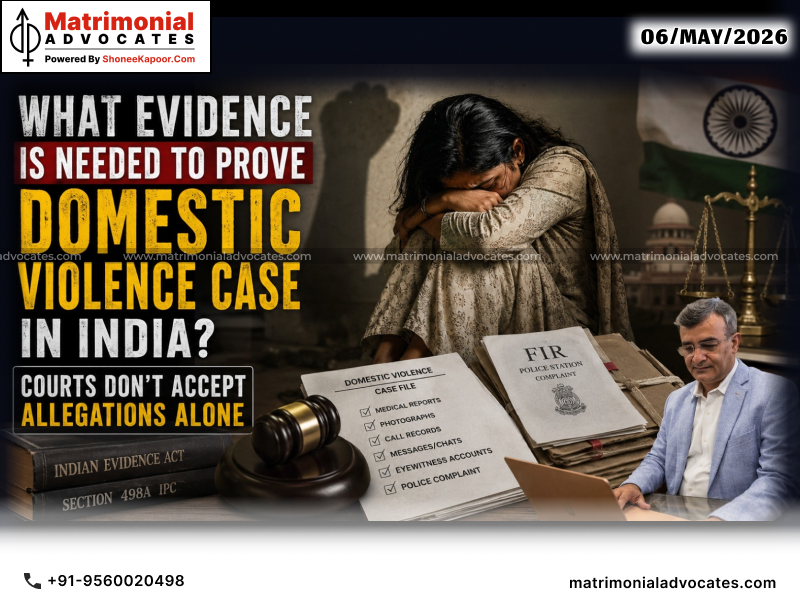
Courts Do Not Decide Domestic Violence Cases On Allegations Alone — Understanding The Evidence Required Under Indian Law
NEW DELHI: Domestic violence litigation in India has increased notably over the last two decades. Allegations today often include not only physical violence, but also emotional abuse, verbal harassment, economic control, threats, intimidation, and disputes arising after matrimonial breakdowns.
However, one important legal principle is frequently misunderstood:
Courts do not automatically accept allegations merely because they are made.
Whether proceedings are filed under the Protection of Women from Domestic Violence Act, 2005, Section 498A IPC, maintenance laws, or related matrimonial litigation, Indian courts examine evidence, consistency, surrounding circumstances, conduct of parties, and the overall probability of allegations before granting reliefs.
At the same time, courts also recognise that genuine victims may not always possess perfect documentary proof of incidents occurring inside a matrimonial home.
Domestic violence cases are therefore decided based on factors such as:
- documentary evidence,
- electronic records,
- witness testimony,
- medical records,
- financial documents,
- police complaints,
- and overall credibility of the parties.
This article explains what evidence Indian courts usually examine in domestic violence cases, how electronic evidence is treated, and the important Supreme Court judgments governing such proceedings.
What Is Domestic Violence Under Indian Law?
Domestic violence in India is primarily governed by the Protection of Women from Domestic Violence Act, 2005 (“DV Act”).
Section 3 Of The DV Act Defines Domestic
The Protection of Women from Domestic Violence Act, 2005 does not restrict domestic violence only to physical assault. The law recognises multiple forms of abuse within a domestic relationship, including physical, emotional, verbal, economic, and sexual abuse.
Physical abuse may include assault, beating, or causing bodily injuries. Verbal and emotional abuse can involve insults, threats, humiliation, and mental harassment. Economic abuse may arise from denial of money, restricting financial access, or withholding maintenance. Sexual abuse includes non-consensual conduct and sexual humiliation.
Who Can File A Domestic Violence Case?
Under the DV Act:
- The complainant must generally be an “aggrieved person”
- There must exist a “domestic relationship”
- The parties must have lived in a “shared household”
Proceedings are typically filed before a Magistrate Court seeking reliefs such as:
- protection orders,
- residence rights,
- maintenance,
- compensation,
- custody orders,
- and injunctions.
Standard Of Proof In Domestic Violence Cases
Domestic violence proceedings under the DV Act are largely civil in nature for grant of reliefs.
Therefore, courts generally apply the standard of:
“Preponderance Of Probabilities”
This means:
- the court examines which version appears more probable,
- more consistent,
- and more believable based on the material on record.
This standard is lower than criminal prosecution under Section 498A IPC, where allegations must ultimately be proved “beyond reasonable doubt.”
Types Of Evidence Commonly Used In Domestic Violence Cases
Courts examine multiple forms of evidence while deciding domestic violence disputes.
Medical Evidence: Medical evidence is often one of the strongest forms of corroboration in physical abuse allegations.
Common Medical Evidence:
- MLC reports
- Injury reports
- X-rays
- Hospital records
- Psychiatric treatment records
- Prescription slips
- Medical photographs
Courts usually expect prompt medical documentation in serious physical assault allegations. However, absence of medical evidence alone does not automatically defeat a complaint, especially in cases involving emotional, verbal, or economic abuse.
Electronic Evidence: Electronic evidence now plays a major role in matrimonial litigation.
Common Electronic Evidence:
- WhatsApp chats
- Emails
- Call recordings
- Audio clips
- CCTV footage
- Screenshots
- Social media posts
- Digital transactions
- Mobile phone records
These records may help establish threats, abusive conduct, admissions, financial demands, or contradictions.
Electronic records are governed by the Indian Evidence Act, 1872, and Section 65B certificates may become relevant. The Supreme Court judgment in Anvar P.V. v. P.K. Basheer remains a leading authority on admissibility of electronic evidence.
Witness Testimony: Witnesses often play an important role in domestic violence proceedings.
Common Witnesses:
- Neighbours
- Relatives
- Friends
- Domestic workers
- Doctors
- Family members
Courts usually distinguish between independent and interested witnesses. Testimony only from close relatives may be scrutinised more carefully if no independent corroboration exists.
Financial & Economic Evidence: Economic abuse is specifically recognised under the DV Act.
Common Financial Evidence:
- Bank statements
- Salary slips
- Income tax returns
- Jewellery bills
- Property papers
- Loan records
- Investment documents
- Digital payment records
These documents may help establish financial capacity, economic deprivation, concealment of income, or alleged financial misconduct.
Police Complaints & Prior Litigation Records: Courts frequently examine:
- FIRs
- NCRs
- Women Cell complaints
- CAW Cell records
- Prior DV proceedings
- Maintenance cases
- Divorce litigation
- Settlement documents
Consistency across proceedings is extremely important. Contradictory statements or unexplained delays in complaints may affect credibility depending on the facts of the case.
How Courts Assess Credibility In Domestic Violence Cases
Judges do not decide matrimonial disputes mechanically.
Courts assess the overall probability of allegations by examining:
- consistency of statements,
- timeline of events,
- delay in complaints,
- documentary support,
- conduct of parties,
- independent corroboration,
- cross-examination performance,
- and surrounding circumstances.
Factors Courts Frequently Examine
Delay In Filing Complaint: Unexplained delay may weaken credibility in some cases.
Continued Cohabitation: If parties continued living normally after alleged incidents, courts may examine whether allegations appear exaggerated.
Contradictions: Differences between FIRs, affidavits, complaints, and testimony may affect reliability.
Over-Implication Of Relatives: Courts have repeatedly criticised routine implication of distant relatives without specific allegations.
Conduct During Litigation: Threats, extortion attempts, inconsistent settlement positions, or contradictory statements may influence judicial assessment.
Common Indicators Courts Examine In False Implication Cases
Courts often examine surrounding circumstances and inconsistencies to determine whether allegations appear genuine, exaggerated, or motivated by matrimonial disputes.
- omnibus allegations,
- lack of dates or specifics,
- contradictory versions,
- delayed complaints,
- absence of independent evidence,
- sudden allegations after matrimonial disputes,
- improvement in statements over time.
Remedies Available To Falsely Accused Persons
Depending on facts, legal remedies may include:
- quashing petitions,
- discharge applications,
- defamation proceedings,
- perjury complaints,
- malicious prosecution claims,
- or evidentiary challenge during trial.
However, every case depends entirely upon its factual matrix.
Important Supreme Court Judgments On Domestic Violence Evidence
Arnesh Kumar v. State of Bihar: Supreme Court issued safeguards against automatic arrests in matrimonial disputes and recognised misuse concerns.
Kahkashan Kausar v. State of Bihar: Court criticised vague and omnibus allegations against relatives in matrimonial disputes.
Preeti Gupta v. State of Jharkhand: Supreme Court warned against exaggerated allegations and misuse of matrimonial criminal proceedings.
Rajesh Sharma v. State of U.P.: Court discussed misuse concerns and procedural safeguards in matrimonial litigation.
Anvar P.V. v. P.K. Basheer: Landmark judgment governing admissibility of electronic evidence under Section 65B.
CONCLUSION
Domestic violence laws in India exist to protect genuine victims from abuse occurring within domestic relationships. However, courts do not mechanically accept allegations merely because they are made.
Judicial determination ultimately depends upon:
- evidence,
- consistency,
- credibility,
- corroboration,
- conduct,
- and overall probability.
Medical records, electronic evidence, witness testimony, financial documentation, police complaints, and litigation history frequently play an important role in determining the truth.
At the same time, Indian courts have repeatedly cautioned against vague, exaggerated, and omnibus allegations capable of destroying entire families without sufficient material.
Every domestic violence case therefore turns on facts, evidence, and careful judicial scrutiny — not allegations alone.
FAQs
- Is medical evidence mandatory in a domestic violence case?
No. Domestic violence may also be proved through witness testimony, electronic evidence, surrounding circumstances, and conduct of parties.
- Are WhatsApp chats and call recordings valid evidence?
Yes. Courts may consider WhatsApp chats, emails, and recordings if they are relevant and properly proved under law.
- Can a domestic violence case succeed without witnesses?
Yes. Many incidents occur inside the matrimonial home, so courts may rely on other supporting evidence and overall credibility.
- Can false domestic violence allegations be challenged?
Yes. False or exaggerated allegations may be challenged through cross-examination, quashing petitions, and other legal remedies.
- Do courts accept allegations without proof?
No. Courts examine evidence, consistency, surrounding circumstances, and probability before granting reliefs or recording findings.