
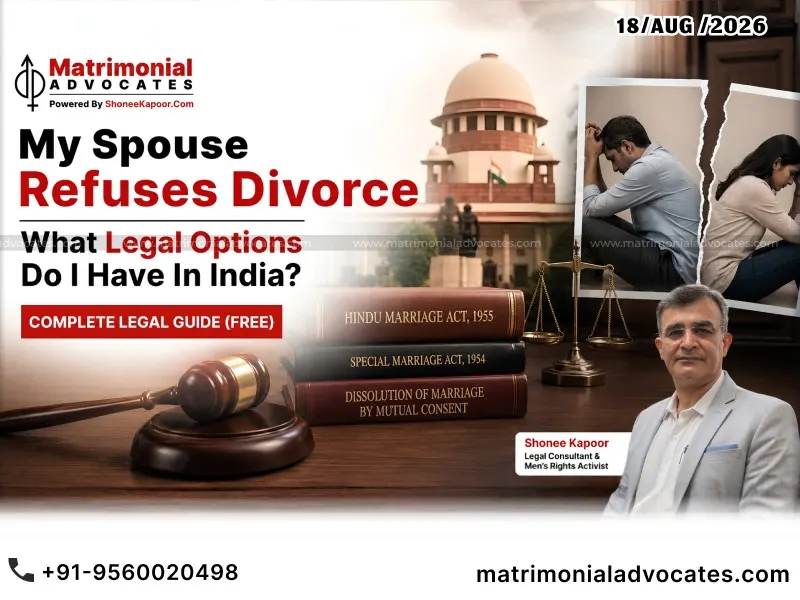
Spouse refusing divorce in India? Know contested divorce grounds, Section 13 HMA, withdrawal of mutual consent and the latest Supreme Court law.
NEW DELHI: A spouse can refuse a mutual-consent divorce. But that does not give them an absolute veto over every divorce proceeding in India.
Marriage is a legal relationship, not a hostage contract. But Indian law also does not grant divorce merely because one spouse says, “I want out.”
The first question is simple: Are you seeking mutual-consent divorce or contested divorce?
That distinction changes everything.
This article primarily explains the position under the Hindu Marriage Act, 1955 (HMA) and the Special Marriage Act, 1954 (SMA). The statute governing your marriage must always be identified before deciding the remedy.
CAN MY SPOUSE SIMPLY REFUSE TO GIVE ME DIVORCE?
They can refuse mutual consent. They cannot prevent you from filing a contested divorce on a legally recognised ground.
Section 13B HMA deals with divorce by mutual consent. In Sureshta Devi v. Om Prakash (1991), the Supreme Court made the position clear: mutual consent must continue until the divorce decree is passed. If one spouse withdraws consent before the decree, the court cannot convert that proceeding into a mutual-consent divorce against that spouse.
But that only ends the mutual-consent route.
It does not prevent the other spouse from pursuing divorce under Section 13 HMA if the facts establish a statutory ground. Section 27 SMA similarly provides for contested divorce for marriages governed by that Act.
WHAT ARE MY OPTIONS IF MY SPOUSE REFUSES DIVORCE?
For a marriage governed by the HMA, common contested grounds include:
- Cruelty under Section 13(1)(ia);
- Adultery under Section 13(1)(i); and
- Desertion for a continuous period of at least two years immediately before filing under Section 13(1)(ib).
These are legal grounds—not labels to be casually added to a petition.
A bad marriage is not automatically legal cruelty. A spouse refusing to sign divorce papers is also not, by itself, a statutory ground for divorce.
Your case must be built on facts, chronology and evidence.
SUPREME COURT: FALSE COMPLAINTS CAN BECOME MENTAL CRUELTY—DEPENDING ON THE FACTS
In K. Srinivas Rao v. D.A. Deepa (2013), the Supreme Court dealt with a husband seeking divorce on the ground of mental cruelty arising, among other things, from repeated complaints and allegations.
The courtroom proceedings themselves are significant.
The Supreme Court recorded that it personally attempted to counsel the parties in court. The wife was keen to return to the matrimonial home. The husband remained unwilling and conveyed through counsel that repeated false complaints against him and his family had made reunion impossible. The Court therefore proceeded to decide the case on merits.
Ultimately, the Supreme Court found mental cruelty on the facts, set aside the High Court judgment and dissolved the marriage. It also awarded the wife permanent alimony. Importantly, the Court cautioned that its judgment should not be understood as saying that one spouse was necessarily responsible for every aspect of the matrimonial breakdown.
The lesson is important: allegations do not become cruelty simply because you call them false. Their nature, evidence, consequences and surrounding conduct matter.
WHAT IF MY SPOUSE REFUSES TO APPEAR IN COURT?
Ignoring a divorce case does not automatically defeat it—and it does not automatically give the petitioner divorce either.
Section 23 HMA specifically requires the court, even where proceedings are undefended, to satisfy itself that a legal ground for relief actually exists.
So remember:
No appearance does not mean automatic divorce. No consent does not mean automatic dismissal. The ground still has to be proved.
IS LONG SEPARATION ENOUGH TO GET DIVORCE?
This is where a large amount of online legal advice goes wrong.
Irretrievable breakdown of marriage is still not an ordinary statutory ground for divorce under the Hindu Marriage Act.
The Supreme Court expressly reaffirmed this position in Neha Lal v. Abhishek Kumar, 2026 INSC 73. The Court explained that although irretrievable breakdown is not a ground available under the HMA, the Supreme Court itself can, in an appropriate case, use its extraordinary power under Article 142 of the Constitution to do complete justice.
This principle flows from the Constitution Bench ruling in Shilpa Sailesh v. Varun Sreenivasan, where the Supreme Court held that Article 142 can be exercised in an appropriate case even when the other spouse opposes dissolution.
THE 2026 COURTROOM REALITY
Neha Lal v. Abhishek Kumar is particularly relevant to this question.
The husband appeared in person before the Supreme Court and expressly opposed the divorce. The parties had lived together for only 65 days, had remained separated for more than a decade and had filed more than 40 proceedings against each other. The Supreme Court ultimately exercised Article 142 and dissolved the marriage despite the husband’s lack of consent.
But do not misunderstand this judgment.
Article 142 is not a new divorce ground that you can simply plead before a Family Court. It is an extraordinary constitutional power of the Supreme Court.
Long separation may become highly relevant to the factual and legal assessment, but it does not automatically create a statutory HMA divorce ground.
SHOULD YOU STILL TRY MEDIATION?
Yes—where settlement remains realistically possible.
Section 9 of the Family Courts Act, 1984 places a statutory duty on Family Courts to make efforts towards settlement.
A spouse may be refusing divorce because the real dispute concerns maintenance, alimony, child custody, visitation, property, pending cases or settlement terms.
Resolve those issues properly and mutual consent may still become possible.
But never sign a vague matrimonial settlement merely because you are desperate for divorce. Every payment, withdrawal, custody arrangement, document and future obligation should be clearly sequenced and documented.
MY VIEW
If your spouse refuses divorce, stop repeatedly asking them to “give” you divorce.
First identify your legal ground. Then identify your evidence. Then choose the correct proceeding.
For husbands in particular, where the matrimonial dispute is accompanied by maintenance proceedings, domestic-violence litigation, criminal allegations or custody disputes, one consolidated chronology of every allegation, pleading, order and contradictory statement can become extremely important.
Consent is required for mutual divorce. Evidence is required for contested divorce. Do not confuse the two.
A spouse can refuse cooperation.
They cannot rewrite the statute.
FAQs
- Can my spouse refuse divorce forever in India?
They can block mutual-consent divorce, but a contested divorce can still be pursued if you establish a statutory ground. - Can I get divorce without my spouse’s consent?
Yes, potentially. Consent is not required for a contested divorce, but you must plead and prove an applicable legal ground. - What happens if my spouse withdraws consent after filing mutual divorce?
The mutual-consent decree ordinarily cannot be passed if consent is withdrawn before the decree. Sureshta Devi v. Om Prakash remains the leading authority. - Is long separation automatically a ground for divorce?
No. Irretrievable breakdown is not an ordinary HMA ground, although the Supreme Court may exercise Article 142 in exceptional cases. - Can my spouse stop divorce by not appearing in court?
Non-appearance does not create a veto, but divorce is not automatic either. The court must still be satisfied that a legal ground exists.
Legal Disclaimer: This article is for general legal information and educational purposes only and does not constitute legal advice, legal representation, or an advocate-client relationship. Matrimonial remedies depend on the applicable personal law, facts, evidence, and judicial proceedings in each case. Laws and judicial interpretations may change; readers should obtain advice from a qualified legal professional before acting on this information.